.avif)
Residual Value Intelligence vs. One-Off Appraisals: What Infrastructure Teams Actually Need
What is residual value intelligence, and why does it replace one-off appraisals for infrastructure teams? Residual value intelligence is a continuously updated, transaction-backed valuation system that tells infrastructure teams what their energy assets are worth right now, not what they were worth when a consultant last visited. One-off appraisals answer a single question at a single point. Residual value intelligence answers the same question every time a capital, risk, or recovery decision surfaces.
For teams managing utility-scale solar portfolios, the difference between these two approaches is not a product preference. It is a measurable gap in recovery value, bond accuracy, and audit defensibility.
Why One-Off Appraisals Fail Infrastructure Teams
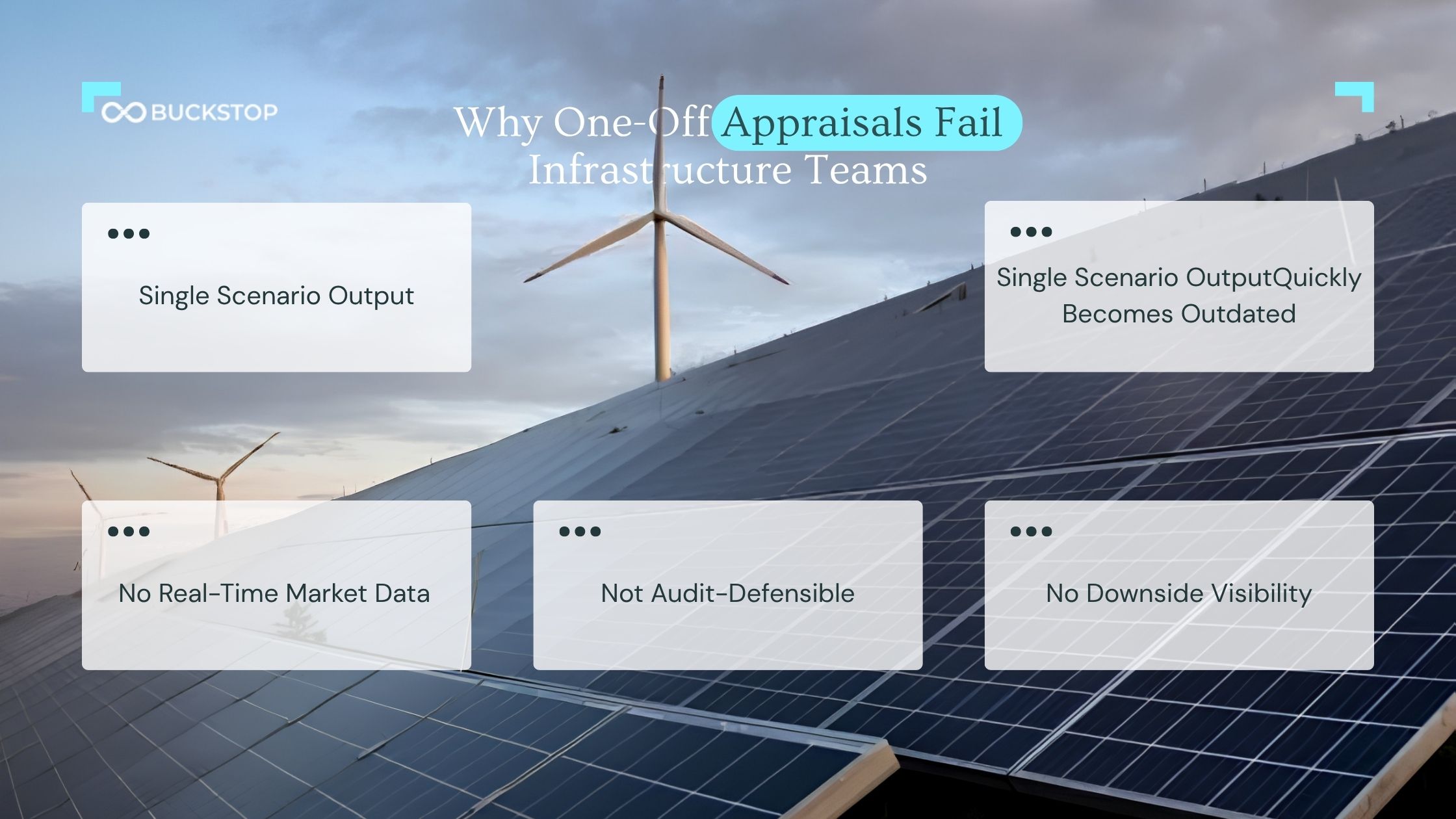
A traditional solar panel residual value assessment costs $8,000 to $15,000 per engagement. It takes four to eight weeks to deliver. The output is a PDF built on a single depreciation scenario, with assumptions that cannot be updated when secondary market prices shift. That study reflects market conditions as of the date it was ordered. Twelve months later, when the asset hits a repowering decision, refinancing, or M&A process, the team pulls it out and uses it anyway. That is where the financial damage happens.
One-off appraisals fail in three specific ways:
They model one scenario. No range, no stress test, no downside case. A credit risk underwriter or capital committee needs a range of outcomes, not a single number with a firm's name on it.
They go stale immediately. Secondary market demand for the resale value of solar equipment changes quarterly. A study ordered in Q1 does not reflect Q3 buyer demand. Teams making resale vs. recycling decisions on outdated data miss the crossover point where resale outperforms disposal by 20% to 30%.
They cannot be audited. When a lender or regulator challenges the assumption, there is no living methodology to defend. There is only a document that no one can update.
What does renewable asset end-of-life value actually cost when mispriced?
Mispriced renewable asset end-of-life value shows up in three quantifiable ways. Mispriced renewable asset end-of-life value manifests in three quantifiable ways: recovery value is left unutilised, decommissioning bonds are sized based on outdated market data, and valuation cycles consume time and budget, compounding across a portfolio. Infrastructure teams relying on static appraisals have documented resale recovery of 20 to 25 percent of portfolio value that internal models had written off as scrap. On a 50MW portfolio, that gap represents millions in overlooked capital. One secondary market buyer benchmarking against live residual value data identified 40 percent upside in recovery scenarios that static depreciation models had not captured.
On the cost side, teams ordering one-off studies every time a material decision surfaces spend $10,000 to $15,000 per engagement and wait six weeks for a number that is already ageing. Multiply that across a portfolio with multiple assets approaching end-of-life simultaneously, and the procurement cost alone becomes a material line item.
How does residual value intelligence fix the bond sizing problem?
Residual value intelligence grounds bond sizing in transaction-backed market data rather than a single analyst's depreciation curve. This means lenders and risk committees can trace assumptions to real resale and scrap outcomes, not to a model built in a spreadsheet with static inputs.
Decommissioning bond sizing based on one-off appraisals routinely overestimates or underestimates true exposure because the market the bond was priced against no longer exists by the time the bond is called. Infrastructure asset valuation built on continuously refreshed benchmarks eliminates that gap. Teams using Buckstop have replaced six-week valuation cycles with audit-ready outputs generated in under 60 seconds.
How do infrastructure teams defend residual value assumptions to a capital committee?
The answer is methodology traceability, not just a number. A capital committee or auditor does not want a PDF from a consultant. They want to see what data the assumption is grounded in, what the downside scenario looks like, and whether the methodology holds up under scrutiny. One-off appraisals cannot provide that on demand. An infrastructure asset valuation platform built on transaction-backed residual value indexes can provide valuable insights. Every output carries a traceable methodology, a confidence score, and a range of scenarios rather than a single point estimate. That is what survives an audit. A static study does not.
Residual Value Intelligence vs. One-Off Appraisals: The Operational Reality
Infrastructure teams managing energy asset lifecycles face a structural problem. Current data is required for transitions that carry the most financial consequence, including repowering, retirement, solar equipment resale, recycling, refinancing, and exit. One-off appraisals are designed for a single transaction at a single moment. They were never built to serve continuous portfolio decisions.
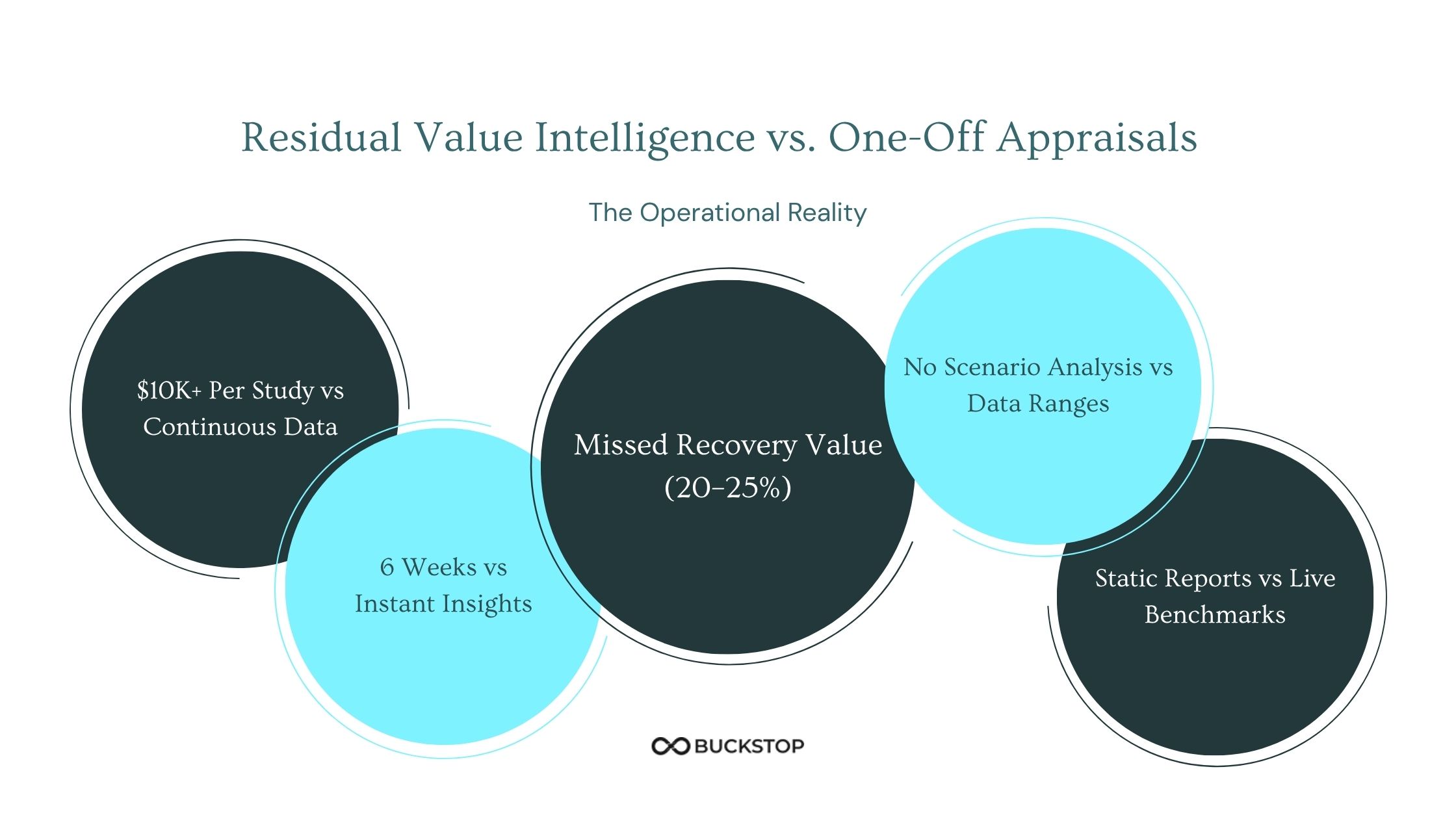
The operational gap is measurable:
- $8,000 to $15,000 per appraisal vs. continuous access to transaction-backed benchmarks
- Six weeks per valuation cycle vs. under 60 seconds with a full audit trail
- 20% to 25% recovery value missed on assets written off as scrap
- 40% upside identified in recovery scenarios static models ignored
- Bond sizing built on stale data vs. assumptions defensible to lenders and regulators today
Teams that treat solar asset residual value as a continuous data problem rather than a periodic procurement exercise operate with a structural advantage. They capture more recovery value. They size bonds accurately. They walk into the capital committee and audit conversations with methodology, not a filing cabinet.
What replaces static depreciation models for solar assets?
Transaction-backed residual value indexes replace static depreciation models for solar assets. Instead of applying a fixed annual degradation curve to book value, residual value intelligence tracks real resale and scrap outcomes from the secondary market, updated continuously as buyer demand, equipment supply, and market conditions move.
Static depreciation models ignore real market behaviours. They produce a number that reflects accounting convention, not what a buyer will actually pay. For infrastructure teams making asset lifecycle decisions worth millions, that distinction determines whether recovery value gets captured or written off.
Buckstop is the residual value intelligence platform built for energy and infrastructure teams managing capital, risk, and recovery decisions across the asset lifecycle. If your team is making those decisions on one-off appraisals, the question is not whether better data exists. It is how much the gap is costing you per portfolio cycle. Book a demo with Buckstop.
FAQs
1. What is residual value intelligence in infrastructure valuation?
Residual value intelligence is a transaction-backed, continuously updated approach that helps infrastructure teams understand the real-time market value of assets instead of relying on static appraisal reports.
2. Why are one-off appraisals not reliable for solar asset valuation?
One-off appraisals provide a single-point estimate that quickly becomes outdated as market conditions change, leading to inaccurate recovery value and poor financial decisions.
3. How does residual value intelligence improve bond sizing?
It uses real transaction data and scenario-based modelling to ensure bond sizing reflects current market conditions, reducing the risk of over- or under-estimation.
4. What are the risks of using static depreciation models?
Static models ignore real market behavior and often misprice asset value, which can result in lost recovery opportunities and incorrect valuation outcomes.
5. How can infrastructure teams make valuation models more accurate?
Teams can improve accuracy by using real-time data, scenario analysis, and transparent, traceable assumptions that align with actual secondary market transactions.

Kristen Shaw
She brings extensive experience in technology marketing, with her 20+ year of experience. Kristen is also the National Marketing Chair for Cleantech Open and is actively involved in the climate technology community. At Buckstop, her work focuses on helping asset owners, lenders, insurers, and investors better understand the value of renewable energy infrastructure throughout its lifecycle.
