Stop guessing on residual risk. Start pricing with intelligence.
Many underwriting decisions still rely on conservative defaults, static depreciation curves, or manual spreadsheets that are hard to defend under scrutiny. The result is over-bonding, excess capital lock-up, and avoidable loss exposure.
Buckstop brings transaction-backed intelligence into underwriting decisions before risk is bound and before claims occur.

The Cost of Manual and
Assumption-Led Underwriting
Excess capital
lock-up
Conservative assumptions inflate bond sizes, premiums, and limits, tying up capital for both insurers and policyholders.
Missed recovery value
Assets written off as “junk” often hold meaningful recoverable value that never gets priced into claims outcomes. Without a defensible benchmark, underwriting defaults to caution instead of accuracy.
Defensibility gaps
Manual spreadsheets and static curves often fail reinsurer, syndicate, or internal review when assumptions are challenged.
The Core Underwriting Question
Are we pricing this risk correctly and can we recover value if something goes wrong?

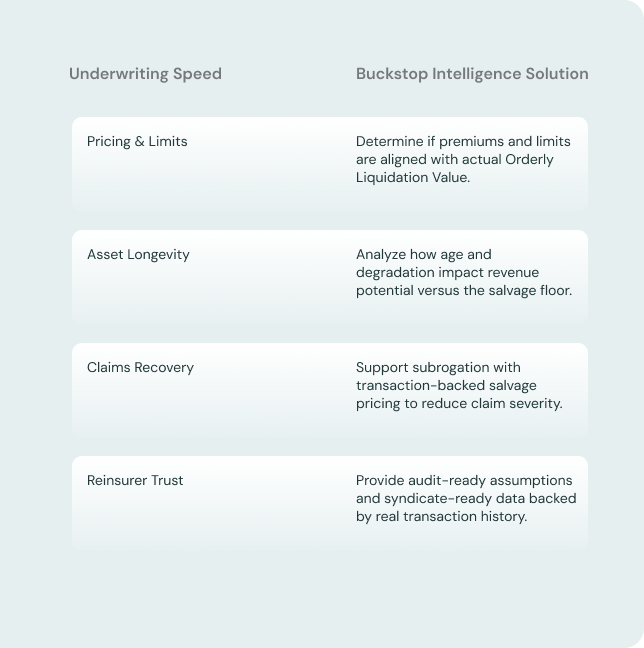
Underwriting Speed
Buckstop Intelligence Solution
Pricing & Limits
Determine if premiums and limits are aligned with actual Orderly Liquidation Value.
Asset Longevity
Analyze how age and degradation impact revenue potential versus the salvage floor.
Claims Recovery
Support subrogation with transaction-backed salvage pricing to reduce claim severity.
Reinsurer Trust
Provide audit-ready assumptions and syndicate-ready data backed by real transaction history.
Built for Speed & Accuracy
"What used to take weeks of analyst effort now runs
in minutes.” - Policy Underwriter based in Texas
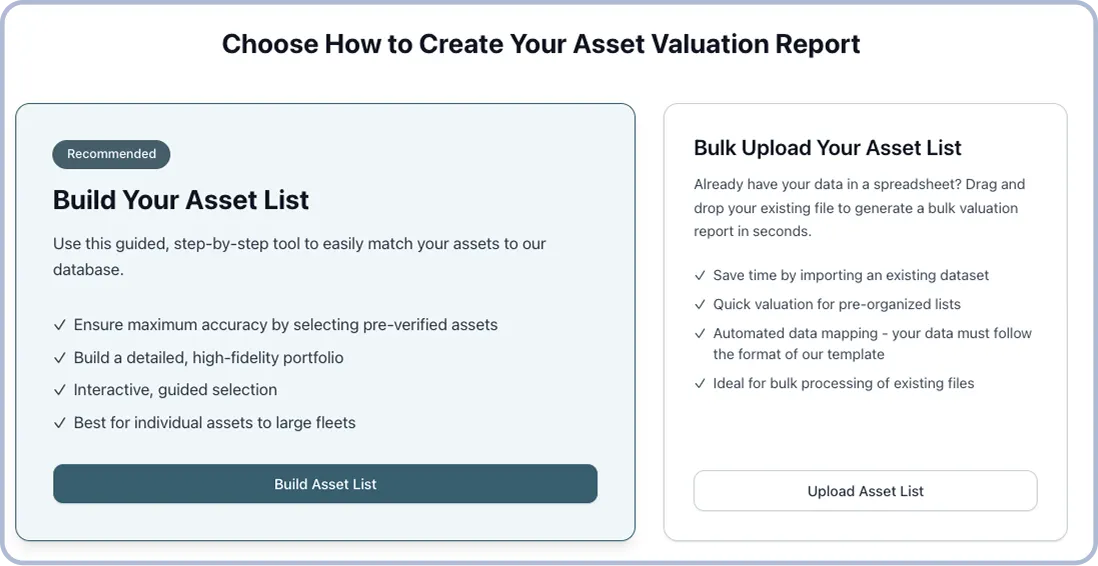
Upload entire portfolios via Excel or structured files for instant benchmarking.
Use our API to feed valuation inputs directly into your existing underwriting workflows.
Instantly validate manufacturer, age, and wattage data against real market outcomes.
The "Secret Sauce": The Buckstop Index
Our platform is powered by a proprietary residual value index built on real-world resale and scrap transactions. This ensures:
single-point guesses; provide a
range of outcomes based on data.
Reducing Net Claims Payouts Through Salvage Intelligence
Buckstop helps insurers
- Identify recoverable value in damaged or impaired assets
- Support subrogation with transaction-backed salvage pricing
- Reduce claim severity by quantifying realistic recovery outcomes
How Buckstop Supports Underwriting Teams
Teams use Buckstop to
- Price decommissioning and salvage exposure using real transaction data
- Benchmark risk automatically from schedule of values data such as manufacturer, age, and wattage
- Validate recovery assumptions across resale, recycling, and scrap pathways
- Quantify downside risk through scenario and sensitivity analysis across loss events
- Reduce underwriting cycle time by replacing repeated manual valuation work with automation
Built to Save Time for Underwriters
Buckstop removes manual bottlenecks by supporting
Bulk asset uploads via Excel or structured files
API-based valuation inputs into underwriting workflows
Repeatable reporting across policies, portfolios, and renewals
A Loss Control Layer Underwriters Can Defend
Buckstop functions as a loss control and decision-support layer by providing
backed by real
transaction history
rather than single-point
assumptions
to data recency and
coverage
for reinsurers, regulators,
and internal review

Index-Backed,
Not Assumption-Driven
At the core of Buckstop is a residual value index built on real resale and scrap transactions. This index powers underwriting decisions with.
Defensible value ranges
Scenario and sensitivity modeling
Consistent application across policies, claims, and portfolios
The same benchmark applies across underwriting, claims, and renewals. No rework. No assumption drift. Reduce residual value risk before it hits your loss ratio.
Frequently Asked Questions
Static depreciation curves and spreadsheets are no longer defensible because they assume linear value decline in a market that behaves non-linearly. Solar asset value is influenced by factors such as secondary market demand, policy incentives, technology shifts, and recovery pathways like repowering or recycling. Spreadsheets typically rely on fixed assumptions that are rarely updated and are not tied to real transaction data. This creates a gap between modeled value and actual recoverable value. As underwriting becomes more scrutinized, especially in large portfolios, relying on static tools exposes insurers and lenders to mispriced risk, audit challenges, and inconsistent decision-making across deals.
Inaccurate salvage value estimation leads to higher net claims payouts because insurers end up overestimating the recoverable portion of an asset after a loss event. When a claim is settled, the expected salvage recovery is deducted from the payout calculation. If this salvage value is inflated or based on unrealistic assumptions, the actual recovery falls short, and the insurer absorbs the difference. Over time, this gap compounds across multiple claims, directly impacting loss ratios. In volatile markets, where asset recovery pathways are uncertain, even small miscalculations in salvage value can translate into significant financial leakage at the portfolio level.
With catastrophe losses reaching record levels, underwriters need to move away from generic assumptions and price decommissioning and salvage risk based on real, pathway-specific outcomes. This means evaluating how assets behave under different damage scenarios and what recovery options are realistically available in each case. Instead of applying blanket percentages, underwriters should incorporate transaction-backed benchmarks, regional recovery conditions, and scenario-based modelling into their pricing frameworks. The focus should shift toward understanding time-to-recovery, variability in salvage demand, and the cost of decommissioning under stressed conditions. This leads to more accurate premiums that reflect actual exposure rather than historical averages.
Reinsurers and syndicates require residual value assumptions that are transparent, data-backed, and consistent across the portfolio. They look for clear justification of how values are derived, including linkage to real market transactions rather than internal estimates. During policy review, they expect to see scenario-based modelling, sensitivity analysis, and alignment between underwriting assumptions and claims expectations. Consistency is critical because fragmented or deal-specific assumptions signal higher risk. Ultimately, they want assurance that residual value is not being used to artificially lower perceived exposure, but is grounded in defensible, repeatable methodology.
Underwriters can avoid repetitive manual valuation by standardizing residual value assessment through indexed, system-driven approaches rather than deal-by-deal spreadsheets. Bulk portfolios require a consistent framework that can be updated dynamically as market conditions change. By using centralized intelligence that reflects transaction-backed benchmarks, underwriters can apply uniform assumptions across assets while still accounting for variability in location, asset type, and lifecycle stage. This eliminates the need to rebuild valuation models at every renewal and allows teams to focus on exceptions and risk signals instead of reprocessing the entire portfolio each cycle.
Over-bonding increases the capital locked into a project, reducing overall efficiency and return on investment. When residual value assumptions are overly conservative, lenders and insurers require larger bonds or reserves to hedge perceived risk. This excess capital is typically carried by asset owners or developers, who must allocate more funds upfront or accept lower leverage. Over time, this impacts project viability, reduces IRR, and limits the ability to deploy capital across additional assets. While it may appear as a risk buffer, over-bonding often reflects uncertainty rather than actual exposure, creating inefficiencies that ripple across the financing structure.
Assumption drift occurs when residual value estimates change across underwriting, claims, and renewals due to inconsistent methodologies or outdated data. Buckstop addresses this by providing an index-backed approach that anchors all stages of the lifecycle to the same transaction-based intelligence. This ensures that the assumptions used during underwriting are aligned with how claims are evaluated and how renewals are priced. By continuously updating benchmarks based on real market activity, Buckstop eliminates the need for subjective adjustments and reduces discrepancies over time. The result is a consistent, defensible valuation framework that improves accuracy, reduces friction between stakeholders, and strengthens confidence across the portfolio lifecycle.
.png)