.png)
Decision-Grade Residual Value Outputs for Energy and Industrial Assets
Residual value is one of the most important and least understood variables across energy and industrial assets.
Buckstop delivers decision-grade residual value outputs, built on transaction-backed market intelligence.A continuously updated view of what your assets are actually worth at end of life across different recovery pathways.
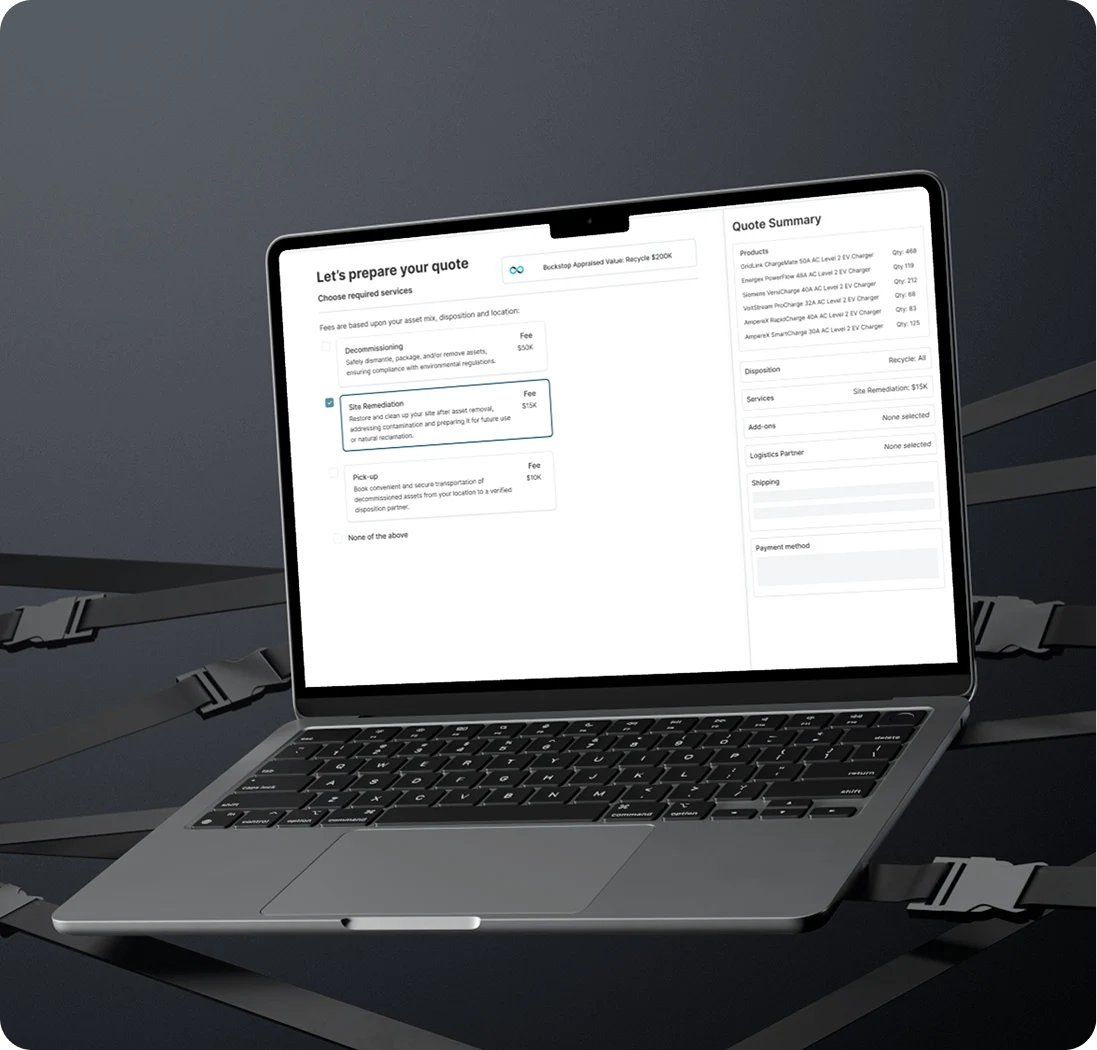
Decision-Grade Outputs, Not Point Estimates
We ingest and structure market data across asset types, geographies, and lifecycle stages to create a consistent and comparable valuation framework.
Grounded in real-world transactions
markets
resale, refurbishment,
recycling, and scrap
valuation across resale,
recycling, and scrap
level outputs for
consistent decision making
These outputs are built to be used across transactions, portfolios, and underwriting models.
Built on Real Market Activity
Buckstop’s intelligence layer is grounded in real-world
transactions across resale, reuse, recycling, and scrap markets.
Market normalization across regions and asset conditions
Continuous calibration as new transactions occur
Sensitivity analysis to understand exposure across key variables
This removes the false precision that comes with static models and replaces it with clarity.
Built for Real Decisions
Residual value impacts decisions long before an asset reaches end of life.
Buckstop’s outputs are structured to support:
Understand how residual value impacts IRR, DSCR, and long-term asset performance
Price exposure accurately using transaction-backed recovery values
Evaluate resale vs recycling vs scrap pathways with real market benchmarks
Make timing decisions based on actual recovery potential, not assumptions
Why This Is Different
Most valuation approaches break because they rely on proxies.
 Book value is not market value
- Depreciation does not reflect recovery potential
- Static studies become outdated quickly
Buckstop replaces static assumptions with transaction-backed, continuously updated intelligence. It delivers clear, pathway-level valuation and decision-grade outputs you can actually act on.
.webp)
Apply Decision-Grade Residual
Value Outputs to Your Assets
See how Buckstop models value ranges, pathways, and downside exposure for your asset set and decision context.