.avif)

Maryland Solar Regulations: A 2026 Guide to Siting, Permitting, Decommissioning, and End-of-Life Risk
That includes citing evidence, community engagement, decommissioning cost estimates, salvage assumptions, financial security, waste handling plans, and documentation that can survive regulatory, financing, and insurance review.
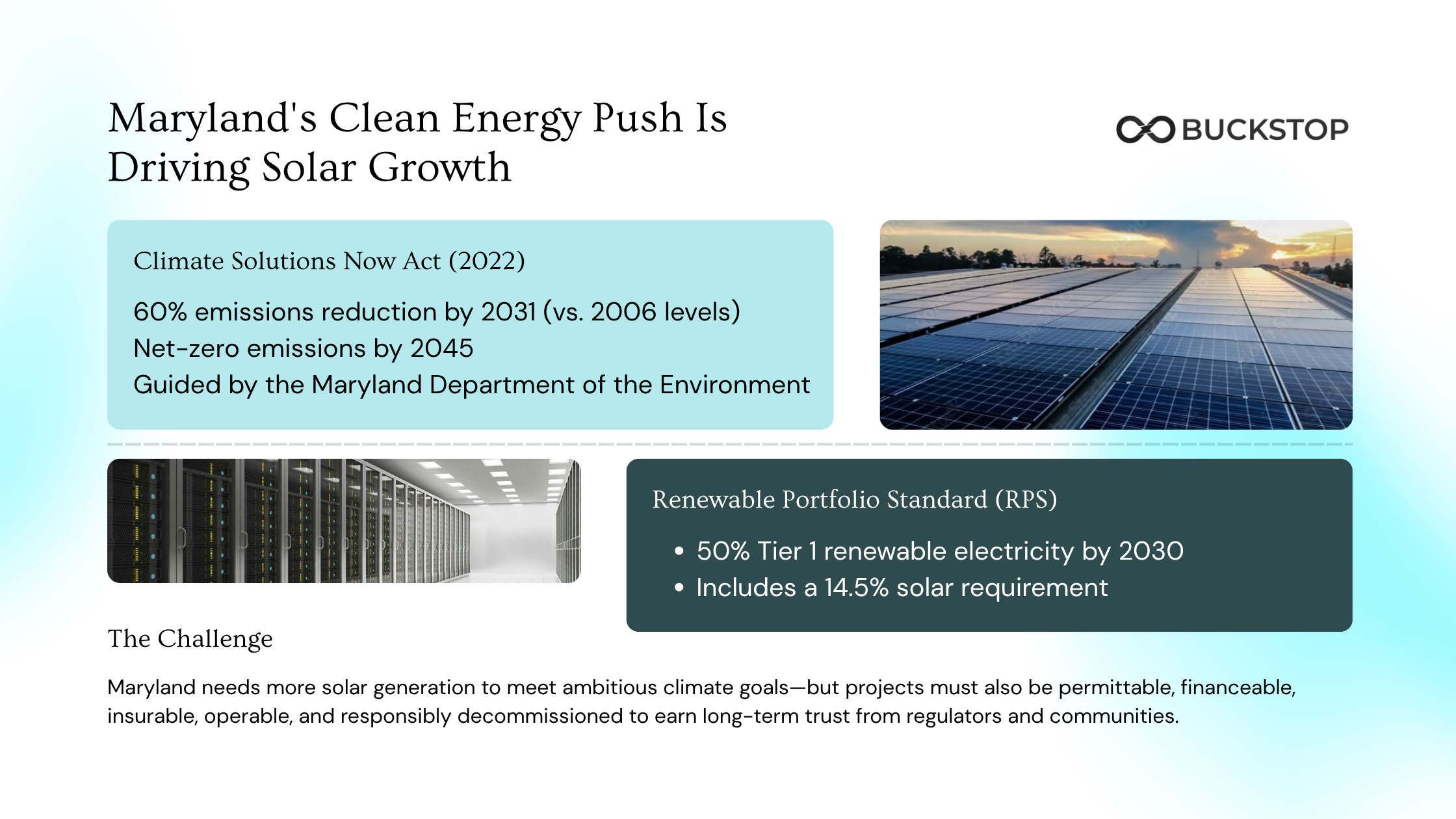
Maryland’s climate and renewable energy policy framework
- MD Climate Solutions Now Act of 2022 (CSNA)
- MD Renewable Energy Portfolio Standard (RPS)
Maryland’s solar regulations sit inside a broader climate and energy policy framework.

Solar siting, land use, and local zoning limits
- MD Renewable Energy Certainty Act (RECA) — HB 1036 / SB 931 (2025)
- MD County Zoning Authority + Smart Growth
The most important recent change is the MD Renewable Energy Certainty Act (RECA) — HB 1036 / SB 931 (2025).
RECA created statewide siting requirements for certain solar energy generating stations and limited the ability of local jurisdictions to prohibit projects that meet state standards. Under Public Utilities Article § 7-218, covered solar projects must comply with requirements related to setbacks, vegetative screening, viewshed impacts, emergency response notice, soil protection, landscaping bonds, lighting, height limits, and decommissioning.
The siting requirements are specific. Covered solar energy generating stations generally must provide a 150-foot boundary from the nearest wall of a residential dwelling and a 100-foot boundary from property lines, excluding property lines that bisect the interior of a project area. Projects must also mitigate visual impacts on preservation areas, rural legacy areas, priority preservation areas, public parks, scenic rivers or byways, designated heritage areas, and historic structures or sites.
Landscaping is treated as a compliance obligation, not just a design feature. Buffers must provide four-season visual screening, use multilayered rows of trees and shrubs, be predominantly native to the region, and be designed to provide screening within five years. The statute also requires a 90% survival threshold for the life of the project and a landscaping bond equal to 100% of the total landscaping cost for the first five years.
This is where MD County Zoning Authority + Smart Growth still matters. RECA limits local governments from simply prohibiting compliant covered solar projects, but local jurisdictions still play a role in site development review, stormwater management, grading, inspections, local permits, and planning. Local zoning is no longer the only gate, but local process still matters.
CPCN approval and utility-scale solar permitting
- MD CPCN for Utility Solar — Public Utilities Article § 7-207
- MD Renewable Energy Certainty Act (RECA) — HB 1036 / SB 931 (2025)
Maryland’s Certificate of Public Convenience and Necessity, or CPCN, remains central for larger solar projects.
The MD CPCN for Utility Solar — Public Utilities Article § 7-207 requires a CPCN before construction of certain generating stations, qualified generator lead lines, or certain energy storage devices can begin. A CPCN is the state approval that provides authority to construct or modify a new generating station or high-voltage transmission line.
The CPCN process is important because it often becomes the place where solar project risks are reviewed together: land use, community impact, environmental effects, grid reliability, decommissioning, and financial assurance.
Public Utilities Article § 7-207 also includes exclusions and special treatment for certain smaller generating facilities. For example, the statute excludes certain facilities with capacity of not more than 2 MW AC, and it addresses specific solar photovoltaic configurations across same or adjacent properties.
RECA adds another layer by creating a more standardized path for certain solar energy generating stations and distributed generation projects. The result is a tiered Maryland solar approval landscape. Some projects are small enough to avoid the full CPCN process. Some require PSC approval. Some community solar projects may fall into newer distributed generation approval pathways. But all covered projects need stronger documentation than they did in the past.
Community solar regulation
- MD Community Solar Energy Generating Systems Program
- COMAR 20.62
Maryland’s MD Community Solar Energy Generating Systems Program is now a permanent part of the state’s solar market.
Community solar has existed in Maryland since 2015, when the state directed the Maryland Public Service Commission to develop a Community Solar Pilot Program. The pilot program was codified through Commission Rulemaking 56, which established COMAR 20.62 for Community Solar Energy Generating Systems. In 2023, Maryland passed House Bill 908, which amended Public Utilities Article § 7-306.2 and established a permanent Community Solar program.
COMAR 20.62 covers general rules, program rules, program administration, program data, consumer protection, and consolidated billing.
Community solar projects carry several layers of compliance. They must meet PSC program rules, utility interconnection requirements, subscriber rules, consumer protection requirements, low- and moderate-income participation requirements, and project size limits.
Decommissioning and financial assurance
- MD Solar Decommissioning Guidance — MDE/PSC (2023)
- MD Renewable Energy Certainty Act (RECA) — HB 1036 / SB 931 (2025)
- MD CPCN for Utility Solar — Public Utilities Article § 7-207
- MD HB 1653 (2018) — Solar Electric Facility Decommissioning & Restoration Security Fund
Maryland’s decommissioning requirements are one of the most important parts of the 2026 regulatory landscape.
Maryland’s solar decommissioning framework has developed through a combination of PSC review, Power Plant Research Program guidance, CPCN proceedings, and newer statutory requirements under RECA. Together, these materials show that Maryland expects project owners to plan for end-of-life removal, site restoration, financial assurance, and responsible handling of project materials.
Under RECA, an owner of a covered solar energy generating station must enter into a decommissioning agreement with the PSC, post a surety bond with the PSC for not more than 125% of the estimated future cost of decommissioning the solar energy generating station and related infrastructure, less any salvage value, and execute a bond true-up every five years.
This is where valuation becomes directly relevant.
If salvage value is used to reduce the bond amount, that value needs to be defensible. Overstating salvage value can understate the financial security needed to restore the site. Understating salvage value can inflate the bond and make the project appear more costly than it is. Either way, the number matters.
Maryland has been moving toward this issue for years. MD HB 1653 (2018) — Solar Electric Facility Decommissioning & Restoration Security Fund would have required the PSC to establish a surcharge on certain solar electric generating facilities and deposit the revenue into a Maryland Solar Electric Generating Facility Decommissioning and Restoration Fund. The bill was withdrawn by sponsor, but it shows that decommissioning security has been part of Maryland’s solar policy debate for years.
Solar panel waste, hazardous waste, and universal waste
- MD COMAR 26.04 — Hazardous Waste & Universal Waste Rules
- Federal RCRA hazardous waste rules
- EPA universal waste proposal for solar panels
End-of-life solar panels are not automatically hazardous waste, but they cannot be ignored.
The MD COMAR 26.04 — Hazardous Waste & Universal Waste Rules are part of Maryland’s waste management framework. For solar projects, the key issue is whether end-of-life panels, batteries, and related equipment must be handled as hazardous waste, universal waste, recyclable material, reusable equipment, or solid waste.
Federal RCRA rules also matter. Some end-of-life solar panels may not be hazardous waste, while others may contain enough regulated metals, such as lead or cadmium, to meet the definition of hazardous waste. EPA has also been working on a proposal to add hazardous waste solar panels to the federal universal waste regulations.
That distinction matters. Solar panels should not be casually described as “universal waste” in Maryland unless the applicable law, waste determination, or future rulemaking supports that classification.
Battery energy storage
- MD PSC Order 89664 (Case 9619) — Energy Storage Pilot Program (BGE, Pepco-MD, Delmarva-MD, Potomac Edison)
- Senate Bill 573 of 2019
- RECA front-of-the-meter energy storage provisions
Maryland solar regulation increasingly overlaps with battery energy storage regulation.
The MD PSC Order 89664 (Case 9619) — Energy Storage Pilot Program (BGE, Pepco-MD, Delmarva-MD, Potomac Edison) traces back to Senate Bill 573 of 2019, also known as the Energy Storage Pilot Project Act. SB 573 required the Maryland Public Service Commission to establish the Maryland Energy Storage Pilot Program.
In Case No. 9619, BGE, Pepco, Delmarva, and Potomac Edison filed energy storage project applications. On November 6, 2020, the PSC issued Order No. 89664 approving six energy storage pilot project proposals.
For solar-plus-storage projects, this matters because BESS changes the project risk profile. It introduces additional considerations around interconnection, fire safety, operational control, capacity value, insurance, maintenance, decommissioning, and end-of-life battery handling.
RECA also expanded state oversight of front-of-the-meter energy storage devices. As solar and storage become more closely linked, project owners should expect solar siting, storage approval, and decommissioning requirements to be reviewed together more often.
Forest conservation and environmental siting
- MD State Forest Conservation Act (Solar Siting Implications)
- MD County Zoning Authority + Smart Growth
Maryland’s MD State Forest Conservation Act can affect solar projects that involve forest clearing, grading, subdivision, or land disturbance.
The Forest Conservation Act was enacted to integrate forest protection into the earliest stages of land planning and development. The Act is administered through both state and local review. Counties and municipalities with approved local forest conservation programs review most projects in their jurisdictions, while the Maryland Forest Service reviews projects in jurisdictions without approved local programs and certain projects that remain under state review.
This also connects back to MD County Zoning Authority + Smart Growth. A parcel that looks viable from an interconnection standpoint may become more complicated once forest conservation, stormwater, visual screening, agricultural preservation, Smart Growth planning, and local site review are considered together.
Community engagement and environmental justice considerations
- MD Renewable Energy Certainty Act (RECA) — HB 1036 / SB 931 (2025)
- MD Climate Solutions Now Act of 2022 (CSNA)
Maryland’s solar rules also build in community process.
Under § 7-218, when the PSC or a local jurisdiction verifies whether a solar project meets the siting and decommissioning requirements, and the proposed project is located in an area considered overburdened and underserved, the project owner must hold at least two public meetings in the community where the solar energy generating station is to be located. The meetings generally must be held in the county and within 10 miles of the proposed project location.
This requirement matters because community opposition can delay projects, change site design, increase costs, and create reputational issues for owners and financing parties.
It also connects back to CSNA. Maryland’s climate policy emphasizes not only emissions reduction, but also the need to manage the energy transition in a way that considers historically underserved and overburdened communities.
Historical and proposed Maryland solar legislation to know
- MD HB 1653 (2018) — Solar Electric Facility Decommissioning & Restoration Security Fund
- MD HB 1390 (2020) — CPCN Electric Facilities Study & Procedures
- MD SB 741 (2020) — CPCN Electric Facilities Study & Procedures (Senate)
- MD SB 434 (2025) — ENERGIZE Maryland Act
Not every Maryland solar bill is current law. But historical and proposed bills are still useful because they show where Maryland’s regulatory debates have been heading.
MD HB 1653 (2018) — Solar Electric Facility Decommissioning & Restoration Security Fund would have created a surcharge-funded decommissioning and restoration fund for certain solar electric generating facilities. The bill was withdrawn by sponsor, but it is important because it shows an early legislative attempt to create a statewide solar decommissioning security mechanism.
MD HB 1390 (2020) — CPCN Electric Facilities Study & Procedures focused on CPCN procedures for electric facilities. The bill would have required DNR to complete an independent environmental and socioeconomic project assessment report within 60 days of certain PSC applications and would have required state agencies to forward information to the PSC on a procedural schedule.
MD SB 741 (2020) — CPCN Electric Facilities Study & Procedures (Senate) was the Senate companion to HB 1390. It carried the same title and similar CPCN study and procedure concepts.
MD SB 434 (2025) — ENERGIZE Maryland Act was introduced as the Empowering New Energy Resources and Green Initiatives Toward a Zero-Emission Maryland Act. The bill proposed changes to Maryland’s clean energy framework, including renaming the Renewable Energy Portfolio Standard as the Clean Energy Portfolio Standard and changing clean energy percentage requirements.
The Business Impact of Maryland’s 2026 Solar Regulations
Maryland’s 2026 solar regulatory environment is not just a permitting issue. It changes the risk profile of the asset.
The Compliance Standard Is Getting Higher
Maryland is trying to accelerate solar deployment while making the rules more predictable. But predictability does not mean simplicity.
The state’s current framework requires project owners to prove more: where the project can be built, how it will affect nearby communities, how the site will be maintained, how the project will be removed, what the end-of-life cost will be, and whether salvage or resale value can reasonably offset that cost.
In 2026, the strongest Maryland solar projects will not be the ones with the most optimistic assumptions. They will be the ones with the best documentation.
That means clear siting evidence, defensible decommissioning estimates, real market support for salvage value, and a lifecycle plan that connects permitting, financing, insurance, and end-of-life obligations from the start.

Grayson Shor
CPO & Co-FounderBefore Buckstop, he led Amazon Worldwide Operations’ circular economy and battery sustainability program, supporting operations across 20 countries. Grayson also served as a U.S. diplomat and the U.S. State Department’s first Climate Security Analyst. His work today focuses on renewable energy asset intelligence, critical minerals, residual value, and building more efficient markets for the assets and materials powering the energy transition.
