

How Insurers Should Value BESS Assets for Property Coverage and Claims
Battery energy storage systems (BESS) are becoming an increasingly important part of renewable energy portfolios. But for property insurers, determining what these assets are worth is more complicated than assigning a replacement cost to a battery installation.
A BESS facility contains multiple interconnected components, each with different replacement costs, useful lives, degradation patterns, and exposure to physical damage. Battery chemistry, system configuration, installation conditions, and technology availability can all influence the value of an insured asset.
For underwriters, inaccurate valuations can result in inappropriate coverage limits, distorted exposure assessments, and unexpected losses. For claims teams, they can complicate decisions about repair, replacement, salvage, and settlement.
The challenge is that the cost of building a battery storage facility, its current market value, and the amount required to restore it after a loss are not necessarily the same.
Understanding these differences is essential to making defensible insurance decisions.
Why BESS Valuation Is Different From Traditional Property Valuation
Traditional property insurance often relies on established replacement cost methodologies, historical construction costs, and relatively predictable asset depreciation.
BESS assets introduce additional variables.
A battery storage facility commissioned five years ago may use technology that has since become less expensive, more efficient, or difficult to source. Its original construction cost may no longer represent the cost of obtaining comparable equipment. At the same time, replacing damaged battery modules may require more than purchasing new units. Differences in battery chemistry, electrical compatibility, thermal management, or control systems can create additional engineering and installation requirements.
Consider two BESS facilities with identical nameplate capacities of 100 MWh.
One uses recently installed lithium iron phosphate (LFP) batteries with readily available replacement modules. The other uses an older battery configuration with limited component availability and different integration requirements. Although both facilities have the same stated energy capacity, their replacement costs, repairability, and potential claims outcomes may differ significantly.
This is why insurers need to evaluate BESS assets at both the system and component levels rather than relying exclusively on installed capacity or original project costs.
The Four Valuation Concepts Insurers Need to Distinguish
Different insurance decisions require different definitions of asset value. Treating them as interchangeable can introduce material discrepancies into underwriting and claims assessments.
Replacement Cost New
Replacement Cost New is particularly relevant when establishing insured values for property coverage.
However, the replacement cost of a BESS facility extends beyond battery modules. It may include power conversion systems, transformers, switchgear, enclosures, cooling equipment, fire protection systems, installation labor, and other necessary infrastructure. Underwriters must also distinguish between replacing an entire facility and replacing an individual damaged component.
Actual Cash Value
Actual Cash Value becomes relevant when policy provisions require depreciation or other adjustments to replacement cost. For BESS, depreciation cannot always be estimated accurately using age alone. Battery degradation, cycling history, operating conditions, and remaining useful life may affect the asset's condition and economic utility.
The applicable ACV methodology ultimately depends on policy language and governing law.
Fair Market Value
Fair Market Value reflects the economic value of an asset in the relevant market rather than the cost of reconstructing it. For BESS facilities, this may be influenced by technology, operating performance, remaining useful life, and market demand. FMV can provide useful context, but it should not automatically replace the valuation basis required by the insurance policy.
Salvage and Recovery Value
Following a covered loss, damaged battery equipment may retain recoverable value.
Some components may be reusable, repairable, or suitable for secondary markets. Others may require specialized handling, recycling, or disposal. A recovery assessment should consider the equipment's condition, safety requirements, marketability, transportation costs, and potential disposition proceeds.
The underwriting implication: Insurers should identify the required valuation basis before assessing the asset. A technically accurate market valuation can still be inappropriate if the coverage requires replacement cost.
What Should Be Included in a BESS Property Insurance Valuation?
A comprehensive BESS valuation requires a clear asset inventory and an understanding of how individual components contribute to the insured facility.
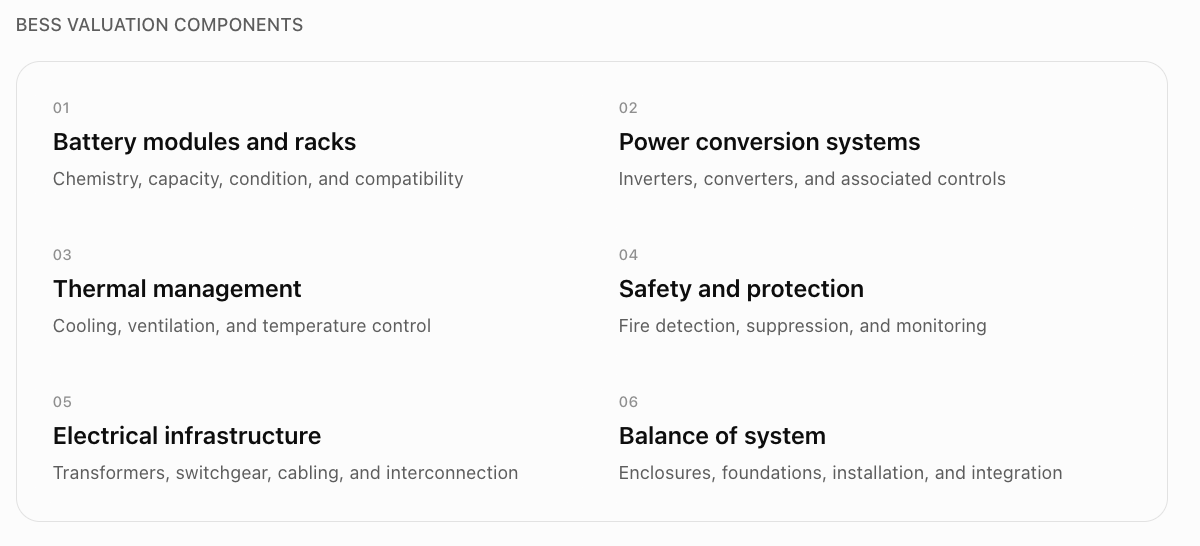
Depending on the policy, valuation may also need to address engineering, commissioning, freight, taxes, contractor costs, and other expenses necessary to restore the insured property. The inclusion of these costs should follow the policy's covered property definitions and valuation provisions.
Five Factors That Can Change BESS Insurance Values
1. Battery chemistry and technology availability
Lithium iron phosphate and nickel manganese cobalt battery systems can have different characteristics, operating requirements, and replacement considerations.
Insurers should understand whether equivalent replacement components remain commercially available and whether substituting newer technology would require system modifications.
2. Degradation and remaining useful life
BESS performance changes over time.
Cycle count, depth of discharge, operating temperature, maintenance history, and battery management practices can influence capacity retention and remaining useful life.
These factors are particularly relevant when assessing depreciated value, repairability, and the economic viability of replacement alternatives.
3. System integration and compatibility
A battery module does not operate independently.
Replacing one component may require changes to battery management software, power conversion equipment, cooling systems, or other integrated infrastructure.
Consequently, the equipment purchase price may represent only part of the actual restoration cost.
4. Installation and location-specific costs
Labor availability, site access, electrical requirements, permitting, and local construction conditions can affect the cost of replacing damaged equipment.
Two identical battery systems located in different markets may have different restoration costs.
5. Market pricing and supply conditions
Battery technology pricing and equipment availability can change substantially over an asset's operating life.
An insured value based on historical capital expenditure may become outdated even when the physical system remains largely unchanged.
Underwriters should therefore distinguish between historical project cost and current replacement economics.
How BESS Valuation Should Inform Underwriting Decisions
Accurate valuation does more than establish an insured amount. It gives underwriters a stronger financial basis for evaluating exposures and coverage structures.
Three decisions are particularly important.
Establishing defensible coverage limits
Underwriters need to determine whether declared values reasonably represent the amount required to restore insured property following a covered loss.
If the declared value is materially below the appropriate replacement cost, the insured may face a coverage shortfall, subject to policy terms.
If the declared value is materially above the appropriate replacement cost, the insured value may misrepresent the exposure and influence pricing or capacity decisions.
A current, component-level valuation helps identify both discrepancies.
Evaluating potential loss severity
BESS risk assessments commonly consider fire, thermal runaway, electrical failure, and other physical damage scenarios.
Valuation adds the financial dimension to these assessments.
For example, an incident affecting one battery enclosure may also damage neighboring equipment or require broader system remediation.
The potential insured loss depends on the physical damage, restoration requirements, applicable coverage, and the costs associated with returning the facility to operation.
Valuation should complement, not replace, engineering and catastrophe risk assessments.
Reviewing portfolio-wide exposure
For insurers covering multiple BESS facilities, inconsistent valuation methodologies can make aggregate exposure difficult to interpret.
One facility may be insured using original construction costs, another using a recent replacement cost estimate, and a third using a generalized cost-per-MWh assumption.
Without standardization, these figures may not be directly comparable.
A consistent valuation framework helps underwriting teams identify where declared values, replacement assumptions, or data-quality issues warrant additional review.
Why Cost-per-MWh Benchmarks Are Not Enough
Installed capacity benchmarks can provide a useful preliminary reference, particularly when reviewing large asset schedules.
But they are not a substitute for a detailed valuation.
Consider this hypothetical, illustrative example:

A simple capacity-based calculation might overlook the costs of specialized equipment, system integration, electrical infrastructure, and site-specific replacement requirements.
A component-level assessment can reveal whether the declared value is appropriate and which assumptions account for the difference.
For underwriters, the goal is not necessarily to increase insured values. It is to ensure that the valuation reflects the coverage being provided.
How BESS Valuation Affects Property Claims
The valuation methodology established during underwriting becomes particularly important when a loss occurs.
Following a BESS incident, claims teams may need to answer several questions:
- Can damaged equipment be repaired, or does it require replacement?
- Are equivalent components available?
- Will replacing one component require changes elsewhere in the system?
- What depreciation or betterment adjustments apply under the policy?
- Does damaged equipment have recoverable value?
- What costs are necessary and covered to restore the facility?
These questions can materially affect the ultimate settlement.
Repair versus replacement
A damaged battery rack may appear suitable for repair, but safety requirements, compatibility issues, or manufacturer restrictions could make replacement necessary.
Conversely, a complete replacement estimate may overstate the loss if certain components can be safely restored.
Claims teams need reliable equipment-level information to evaluate these alternatives.
Technology substitution and betterment
If the original battery technology is no longer available, the insured may need to use newer equipment.
That can raise questions about functional equivalence, system upgrades, and betterment.
A valuation assessment can help distinguish the cost of restoring comparable functionality from the cost of optional improvements, while the policy determines how those costs are treated.
Salvage and recovery opportunities
Damaged BESS equipment may contain recoverable components or materials.
However, potential recovery value must be assessed alongside safety, transportation, handling, and disposal costs.
In some cases, net recovery proceeds may be limited or negative.
Evaluating realistic disposition pathways helps claims teams make more informed recovery decisions without assuming every damaged component has resale value.
A Practical BESS Valuation Checklist for Underwriters
Before accepting or renewing a BESS property schedule, insurers should review the following information.

A complete review does not guarantee that an insured value is accurate, but it helps identify the assumptions and data gaps that require further investigation.
For portfolios with multiple facilities, applying the same checklist across assets can also improve consistency and support more efficient renewal reviews. For additional guidance on evaluating renewable energy asset values for insurance purposes, explore our insurance valuation solutions for brokers, carriers, and sureties to support more informed underwriting and coverage decisions.
Why Periodic BESS Revaluation Matters
A valuation completed at commissioning may not remain appropriate throughout the facility's operating life.
Battery equipment prices can change. Replacement components may become unavailable. Operating conditions can affect asset health. Changes to the facility can alter its insured property schedule.
As a result, insurers should consider revaluation at relevant asset events, including policy renewal, major equipment replacement, repowering, system expansion, or a material change in operating conditions. The frequency of a formal appraisal should reflect the exposure, portfolio characteristics, and underwriting requirements.
However, keeping asset records and replacement cost assumptions current between appraisals can help insurers identify emerging valuation discrepancies earlier.
The objective is to move from static declared values toward a more reliable understanding of current asset replacement economics.
How Buckstop Supports BESS Insurance Valuation
For insurers managing renewable energy exposures, the challenge is not simply obtaining another asset value. It is understanding how that value was established, whether the assumptions remain relevant, and where discrepancies may affect underwriting or claims decisions.
Buckstop provides renewable energy asset valuation intelligence to support these assessments.
Through its valuation capabilities, insurers and insurance stakeholders can establish a more consistent understanding of equipment values, examine valuation assumptions, and identify discrepancies across renewable energy portfolios.
Buckstop's capabilities include:
- Valuation Studio: Supports asset-level valuation analysis using structured equipment information and market intelligence
- Certified Appraisals: Provides independent, USPAP-compliant appraisals when a formal valuation is required
- Portfolio Monitoring: Helps stakeholders monitor asset values and identify changes that may warrant further review
- Asset Recovery Services: Supports evaluation of equipment recovery and disposition opportunities following asset damage or retirement.
For BESS insurance decisions, the appropriate scope depends on the equipment, available data, valuation purpose, and applicable policy requirements.
By combining asset-level information with current market intelligence, insurers can make more informed decisions about declared values, potential valuation discrepancies, and claims recovery alternatives.
Better BESS Underwriting Starts With Better Asset Values
As battery energy storage deployment expands, insurers will need valuation methodologies that reflect the technical and economic characteristics of these systems.
Original construction costs, generalized capacity benchmarks, and outdated equipment schedules may provide useful starting points, but they cannot always explain what it would cost to restore a facility after a loss. A defensible BESS valuation should account for equipment configuration, replacement availability, installation requirements, asset condition, and the valuation basis specified in the policy.
For underwriting teams, this supports more reliable coverage decisions and exposure assessments. For claims teams, it provides a stronger foundation for evaluating restoration costs, depreciation, and recovery options. Ultimately, accurate BESS insurance valuation is about knowing what is insured, what it would cost to restore, and which assumptions support that value.
Know What Your Energy Assets Are Really Worth.
Whether you're reviewing declared values, evaluating renewable energy exposures, or assessing a potential loss, Buckstop helps bring greater clarity to asset valuation decisions.
Explore Buckstop's valuation intelligence: Talk to Buckstop

Alexander Olesen
CEO & Co-FounderA serial entrepreneur and Forbes 30 Under 30 honoree, Alexander previously founded Babylon Micro-Farms and grew the company across five countries. Today, his work focuses on bringing greater transparency to renewable energy asset values, residual value, and recovery markets. He is a University of Virginia graduate, patent holder, and TEDx speaker.
