.png)
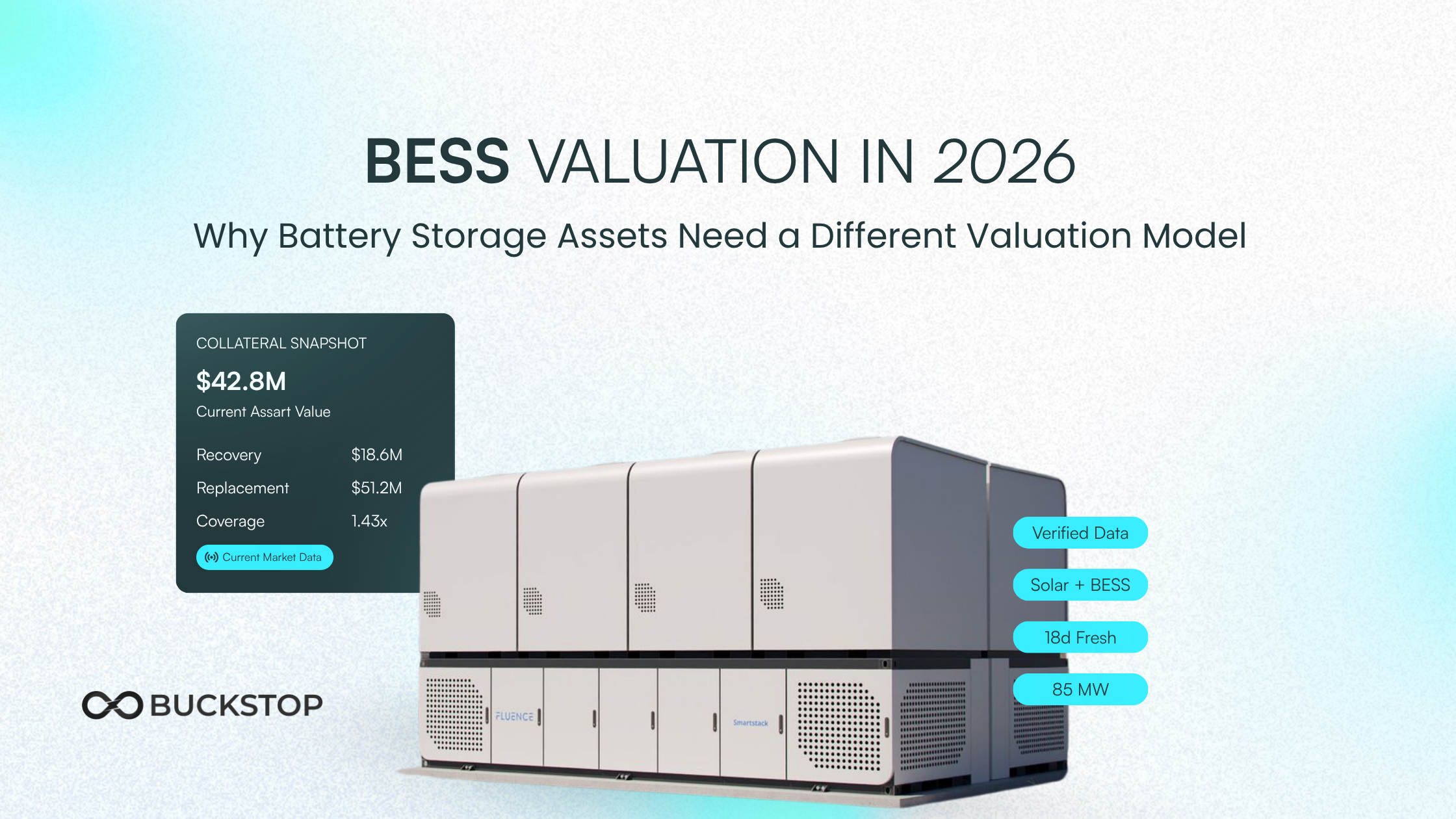
BESS Valuation in 2026: Why Battery Storage Assets Need a Different Valuation Model
A 100 MW / 400 MWh battery energy storage system does not have the same economic profile in Year 1, Year 5, and Year 10.
Its nameplate specifications may look similar on paper. Its value may not.
Unlike many conventional infrastructure assets, a Battery Energy Storage System changes as it operates. Cells degrade. Available energy capacity declines. Cycling patterns affect remaining life. Augmentation may add new equipment to an existing system. Battery technology and equipment pricing can move significantly while the project is still operating. That makes BESS valuation fundamentally different from applying a standard depreciation curve to original project cost. For insurers, lenders, owners, and investors, the better question is not simply:
What did this battery storage system cost?
It is: What is this BESS asset worth today, given the equipment currently installed, its condition, its remaining capability, and today's market?
What Is BESS Valuation?
BESS valuation is the process of determining the current economic value of a Battery Energy Storage System using its equipment characteristics, age, condition, performance, market conditions, replacement economics, and potential recovery value.
Depending on the decision being made, that valuation may focus on:
Valuation
What It Answers
Common Use
Replacement Cost New
What would comparable equipment cost to replace today?
Insurance, SOVs, TIV
Fair Market Value
What is the existing equipment worth in the current market?
Financing, refinancing, M&A, collateral
Salvage Value
What value can be recovered at end of life?
Decommissioning, recovery planning, financial assurance
Buckstop's Valuation Studio applies these three valuation perspectives across solar, wind, and BESS assets, with source transparency and quarterly repricing. For BESS, however, arriving at those values requires understanding variables that do not behave like those of a static asset.
Why BESS Assets Need a Different Valuation Model
A traditional asset valuation model might start with acquisition cost and reduce that value over time according to a depreciation schedule. For battery storage, age alone is a weak proxy for economic conditions.
Two BESS assets commissioned in the same year, using similar equipment and with the same original capacity, can have materially different values five years later.
Why? Because one may have experienced significantly more cycling than the other.
- One may operate in a more demanding thermal environment
- One may have already been augmented
- One may retain substantially more usable capacity
- One may use equipment with an active replacement or secondary market, while the other's components may be obsolete
Research published in Applied Energy in 2026 similarly found that simplified models that ignore detailed battery degradation can distort both investment and operational conclusions. For valuation purposes, the implication is important:
BESS value needs to reflect what has happened to the asset, not simply how long it has existed.
1. Battery Degradation Directly Changes Asset Value
Every lithium-ion BESS experiences degradation.
But degradation is not determined by time alone.
Two major mechanisms are involved:
- Calendar aging occurs as batteries chemically age over time, even when they are not being heavily cycled
- Cycle aging occurs through charging and discharging and is influenced by operating conditions such as cycle frequency, depth of discharge, temperature, state of charge, and C-rate
- The EIA notes that lithium-ion battery capacity degradation occurs both from age and usage, and that battery performance guarantees are typically tailored to the expected BESS use case.
That creates an immediate valuation problem. Imagine two identical 100 MW / 400 MWh systems commissioned on the same date.
Asset A operates under a relatively moderate cycling profile. Asset B is dispatched much more aggressively. Five years later, their chronological age is identical. Their state of health and remaining economic capability may not be. A valuation model based primarily on age could treat them similarly. A BESS-specific model should not.
What degradation can affect
Degradation can influence:
- Available energy capacity
- Remaining useful life
- Future augmentation requirements
- Replacement requirements
- Revenue-generating capability
- Operating economics
- Fair market value
- Residual value
This is why BESS depreciation and BESS valuation should not be treated as interchangeable concepts. Depreciation is an accounting mechanism. Valuation asks what the asset is economically worth today.
2. Augmentation Makes BESS Valuation More Complex
Battery storage introduces another characteristic that complicates conventional valuation: The asset itself can change during its operating life. As battery capacity fades, owners may augment the system by adding additional battery capacity. Augmentation is commonly used to maintain required deliverable capacity as the original cells degrade. That means a BESS commissioned in 2026 may not contain exactly the same equipment configuration as in 2031.
It could contain:
- Original battery modules with five years of degradation
- Newer battery modules added during augmentation
- Different equipment vintages
- Updated controls or balance-of-system components
- Components with different remaining useful lives
Now consider what happens if the project is valued as one homogeneous asset. A single depreciation assumption could assign essentially the same age profile to equipment installed five years apart. That does not accurately represent the value of physical assets.
Augmentation also creates a forward-looking valuation question
If a system has not yet been augmented but is expected to require augmentation, that future requirement can also matter economically. NLR's work on energy-storage lifecycle economics explicitly models augmentation and periodic replacement as future BESS costs, with residual value incorporated into lifecycle calculations.
So a credible BESS valuation needs to understand both: What equipment exists today? and What is likely to be required to maintain the system's intended performance?
3. BESS Replacement Cost Can Move Independently of Original CapEx
Suppose a battery storage project cost $80 million when it was built. That does not mean its replacement cost today is $80 million. Nor does it mean today's replacement cost can be calculated reliably by simply escalating the original figure. Battery markets can move substantially during the operating life of a project.
Changes can occur across:
- Battery cell pricing
- Battery chemistry
- Energy density
- PCS pricing
- Thermal management
- Fire suppression systems
- Controls
- Suppliers
- Manufacturing capacity
- Commodity inputs
- Tariffs and trade policy
Recent 2026 market conditions provide a useful illustration. Battery storage economics have been affected by changes in input costs, including lithium, copper, aluminium, trade conditions, and battery export economics. The point is not whether BESS prices are universally moving up or down.
The point is that they move. That means replacement cost needs to be based on the current equipment market rather than the original project invoice alone.
Why this matters for insurance
An outdated replacement cost can create two problems.
- Understatement: The insured value may not be sufficient to reflect current replacement economics
- Overstatement: The owner may be carrying an insured value materially above the actual cost of replacing the equipment
For Statements of Values and Total Insured Value assessments, current BESS replacement economics therefore matter much more than simply knowing historical installed cost.
4. Why Replacement Cost New Alone Cannot Determine Fair Market Value
Replacement cost and fair market value answer different questions.
Replacement Cost New: What would comparable equipment cost today?
Fair Market Value: What is the existing equipment worth in today's market?
For a BESS asset, the difference can be significant. Consider a battery container that would cost a substantial amount to replace with new equipment. The existing container has already experienced several years of cycling. Its remaining capacity is lower. Its warranty position may be different. Newer battery technology may now offer better performance at a different price. The existing equipment therefore does not automatically have a market value equal to its replacement cost.
A BESS fair market value analysis may need to consider:
- Equipment manufacturer and model
- Battery chemistry
- Age and vintage
- State of health
- Cycling history
- Remaining capacity
- Remaining useful life
- Warranty status
- Current equipment pricing
- Availability of comparable equipment
- Secondary-market transactions
- Reuse or redeployment potential
This is particularly important for refinancing, M&A, portfolio transactions, and collateral analysis, where the decision depends on the current economic value of the equipment rather than simply the cost to replace it.
5. Battery Chemistry Matters to Valuation
Not all batteries age, perform, or recover value in the same way. A BESS valuation should therefore identify what is actually inside the system. Lithium iron phosphate (LFP), nickel manganese cobalt (NMC), and other chemistries have different:
- Performance characteristics
- Degradation profiles
- Material compositions
- Safety characteristics
- Market dynamics
- Recycling economics
Chemistry can therefore influence both operating value and end-of-life recovery value. This becomes particularly important when estimating BESS salvage value. The economic value of the materials recoverable from one battery chemistry may differ from another, and commodity prices can change throughout the project's life. A generic salvage assumption per MWh may therefore miss material differences between systems.
6. Salvage Value Is Not Simply Scrap Value
At the end of a BESS asset's useful life, its economic value does not necessarily fall to zero. But determining what remains requires more than applying a fixed scrap percentage to original cost. BESS salvage value should reflect the recoverable value of equipment and materials after considering the applicable recovery pathway and associated costs.
Potential sources of recovery value can include:
- Battery materials
- Copper
- Aluminum
- Steel
- Power conversion equipment
- Transformers
- Cabling
- Other reusable or recyclable components
But recovery also creates costs. These may include:
- Decommissioning
- Dismantling
- Transportation
- Processing
- Recycling
- Disposal
- Labor
- Hazardous-material handling
Buckstop defines salvage value as end-of-life material recovery value from raw materials and critical minerals, net of decommissioning costs. This distinction matters because gross material value is not the same as net recoverable value. For owners planning decommissioning or financial assurance, that difference can materially affect the economics.
7. BESS Value Is Component-Level, Not Just Project-Level
Another weakness of using a single project-level depreciation curve is that a BESS is not one asset. It is a system composed of equipment with different functions, useful lives, replacement markets, and recovery pathways.
A utility-scale BESS may include:
- Cells
- Modules
- Racks
- Containers
- Battery Management System
- Power Conversion System
- Energy Management System
- Transformers
- Switchgear
- HVAC and thermal management
- Fire detection and suppression
- Cabling and electrical infrastructure
These components do not lose value at the same rate. Some may be replaced during the operating life of the project. Others may remain in service through multiple battery augmentation cycles. A component-level valuation model can provide a more defensible picture than applying one depreciation factor across the entire project's original CapEx.
What Should a BESS Valuation Model Include?
For owners, lenders, insurers, and investors evaluating a BESS asset, the valuation framework should ideally capture four categories of information.
Asset Configuration
What equipment is actually installed? This includes manufacturer, model, chemistry, capacity, power rating, commissioning date, and component configuration.
Asset Condition
What has happened since commissioning? Relevant information can include age, cycling, state of health, degradation, augmentation, equipment replacement, and warranty status.
Current Market
What does comparable equipment cost and transact for today? This can include current equipment pricing, comparable transactions, secondary-market activity, and relevant market conditions.
Recovery Economics
What happens when the equipment leaves service? The valuation should consider reuse, resale, recycling, material recovery, disposal, and associated decommissioning costs. Together, these factors provide a much more useful view of BESS asset value than original CAPEX minus a standardized depreciation rate.
When Should a BESS Asset Be Revalued?
For BESS, valuation should not necessarily be treated as a one-time exercise.
A new valuation may be appropriate around:
- Insurance renewals
- Refinancing
- M&A transactions
- Portfolio acquisitions
- Major augmentation
- Significant degradation
- Equipment replacement
- Repowering
- Decommissioning planning
- Material changes in battery pricing
- Material changes in commodity markets
This is particularly relevant because both sides of the equation can change simultaneously. The physical battery is aging while the external battery market is also changing. A five-year-old valuation therefore does not simply contain five-year-old prices. It may also describe a materially different asset.
From Static BESS Valuation to Current Asset Intelligence
Battery storage is becoming a larger and more important infrastructure asset class. But the valuation methods used around it need to reflect how the technology actually behaves.
The simple model: Original CapEx → Depreciation → Current Value misses too much. A more useful BESS valuation model looks closer to:
Current Equipment + Condition + Degradation + Augmentation + Current Market Pricing + Market Evidence + Recovery Economics = Current Asset Value. And even then, there is not necessarily one universal number.
The appropriate value still depends on the decision. An insurer may need Replacement Cost New. A lender evaluating collateral may need Fair Market Value. An owner preparing for decommissioning may need Salvage Value. For BESS owners managing all three questions, the challenge is keeping those values current as both the asset and the market evolve.
Value Your BESS Based on What It Is Worth Today
Buckstop's Valuation Studio turns BESS equipment data into current Replacement Cost New, Market Value, and Salvage Value, with source transparency and quarterly repricing. The platform also supports insurance SOVs, refinancing reports, certified appraisals, decommissioning studies, and market intelligence.
Instead of relying on original CapEx or a static depreciation assumption, asset owners and financial stakeholders can evaluate the equipment against the market that exists today.
Know what your battery storage assets are worth before the next insurance renewal, refinancing, acquisition, augmentation, or decommissioning decision depends on it.
Get a free BESS valuation that turns your equipment data into current Replacement Cost New, Market Value, and Salvage Value, with source trans parency and quarterly repricing.
Frequently Asked Questions About BESS Valuation
How do you value a Battery Energy Storage System?
A BESS can be valued using replacement cost, fair market value, and salvage value depending on the purpose of the valuation. A robust analysis considers equipment specifications, battery chemistry, age, state of health, degradation, cycling, augmentation history, current market pricing, comparable transactions, and end-of-life recovery economics.
Why can't BESS value be calculated using standard depreciation?
Standard depreciation primarily reduces value according to time or an accounting schedule. BESS performance also changes according to cycling, temperature, operating profile, degradation, augmentation, and technology changes. Two batteries of the same age can therefore have different economic values.
How does battery degradation affect BESS valuation?
Battery degradation reduces usable capacity and can affect remaining useful life, revenue capability, future augmentation requirements, marketability, and residual value. Because degradation depends on both calendar aging and usage, it should be considered when assessing an operating BESS.
What is the difference between BESS replacement cost and fair market value?
BESS replacement cost estimates what comparable equipment would cost to replace today. Fair market value estimates what the existing equipment is worth in the current market given its age, condition, remaining capacity, technology, and market demand. The two values can be materially different.
How does augmentation affect BESS valuation?
Augmentation introduces newer battery capacity into an existing system to compensate for degradation or maintain required capacity. This can create multiple equipment vintages within one project, each with different ages, conditions, remaining lives, and values.
What is BESS salvage value?
BESS salvage value is the net recoverable value associated with equipment and materials at the end of their useful life. It can account for recoverable battery materials, metals, reusable components, recycling value, and relevant decommissioning and recovery costs.
How often should BESS assets be revalued?
There is no universal schedule, but revaluation can be particularly important around insurance renewals, refinancing, M&A, augmentation, major equipment changes, decommissioning planning, or significant changes in battery and commodity markets. For portfolios exposed to changing equipment prices, regular repricing can provide a more current view of asset value.