.avif)
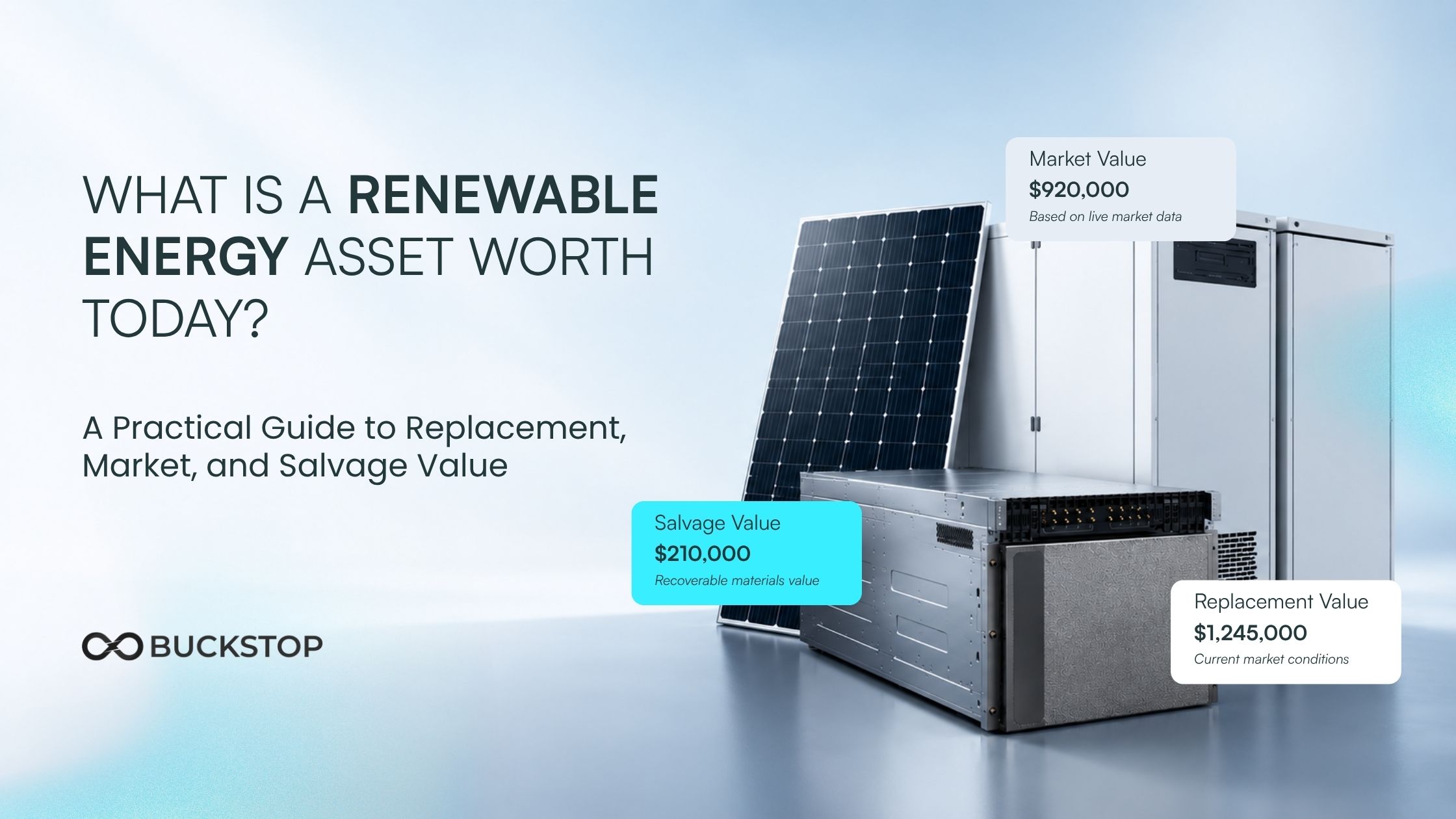
What Is a Renewable Energy Asset Worth Today? A Practical Guide to Replacement, Market, and Salvage Valuations
Ask what a solar project, battery system, or piece of renewable energy equipment is worth, and the first instinct is to look for a number.
But there is rarely just one.
A renewable energy asset can have a replacement cost, a market value, and a salvage value at the same time. Each answers a different financial question.
- For an insurer, the relevant question may be: What would it cost to replace this equipment today?
- For a lender or investor: What could this asset reasonably be worth in the current market?
- For an asset owner planning decommissioning: What value could still be recovered from the equipment and materials at the end of its useful life?
For an asset owner planning decommissioning: What value could still be recovered from the equipment and materials at the end of its useful life?
Understanding these differences has become increasingly important as solar and BESS portfolios age, equipment markets change, projects are refinanced or sold, and asset owners need better visibility into what is sitting on their balance sheets.
Here is how the three values work, where they are used, and why historical project cost alone does not tell you what a renewable energy asset is worth today.
What Is Renewable Energy Asset Valuation?
Renewable energy asset valuation is the process of determining the current economic value of solar, battery storage, wind, or other energy equipment using an appropriate valuation methodology and current market data.
The methodology depends on the decision being made.
For equipment-level renewable energy valuation, three values are particularly useful:
Valuation
The Question It Answers
Common Applications
Replacement Cost New
What would it cost to replace this equipment today?
Insurance, SOVs, TIV assessments
Market Value
What is this physical equipment worth in the current market?
Financing, M&A, refinancing, collateral assessment
Salvage Value
What could be recovered from the equipment or materials?
Decommissioning, recovery planning, financial assurance
These values should not be treated interchangeably.
The number appropriate for an insurance renewal may not be the number a lender should use when assessing collateral. Likewise, neither necessarily represents what an owner could recover when equipment reaches the end of its economic life.
That distinction is central to how Buckstop structures renewable energy asset intelligence. Its Valuation Studio provides Replacement Cost New, Market Value, and Salvage Value through a common valuation workflow rather than treating asset value as one static figure.
1. Replacement Cost New: What Would It Cost to Replace the Asset Today?
Replacement cost new estimates what it would cost at current market conditions to replace an existing renewable energy asset with comparable equipment.
This is particularly important for insurance. Consider a solar project commissioned several years ago. The original project documentation may contain equipment costs from the year the project was constructed. Those numbers tell you what the equipment cost then. They do not necessarily tell you what comparable equipment would cost now.
Several variables can change:
- Equipment pricing
- Technology generation
- Manufacturer and model availability
- Tariffs and trade conditions
- Freight and supply chain costs
- Equipment specifications
- Geographic conditions
- Replacement availability
This is why original installed cost and current replacement cost should not automatically be treated as the same number.
Example
Suppose a solar portfolio was commissioned in 2021. Using its original procurement cost as the basis for a 2026 insurance valuation assumes that the economics of replacing those components have remained essentially unchanged for five years.
That assumption may not hold. Even two projects with the same MW capacity can have different replacement economics because they use different modules, inverters, racking systems, technologies, manufacturers, or equipment vintages.
Buckstop's existing methodology therefore emphasizes component-level current pricing rather than simply carrying forward historical project costs or system-level assumptions.
When is replacement cost new most useful?
Replacement cost new commonly matters for:
Insurance Statements of Values (SOVs)
The insurer needs a defensible basis for the value being insured.
Total Insured Value assessments
Owners, brokers, and carriers need to understand whether current insured values still reflect the assets in the field.
Risk management
A significant gap between assumed and current replacement economics can create underinsurance or unnecessary insurance expense.
The important distinction is simple:
Installed cost tells you what was spent. Replacement cost asks what comparable equipment would cost now.
2. Market Value: What Is the Asset Worth in the Market Today?
Replacement cost new asks what it would cost to replace an asset. Market value asks a different question: what could that asset reasonably be worth in the current market?
That distinction matters. A five-year-old inverter may still be expensive to replace with new equipment, but that does not mean the existing inverter itself is worth the same amount in the secondary market. Market value can be influenced by factors such as:
- Manufacturer
- Model
- Equipment age and vintage
- Technology
- Capacity
- Condition
- Remaining useful life
- Current supply and demand
- Availability of comparable equipment
- Secondary-market transactions
- Compatibility with existing projects
- Geographic location
This makes market value especially relevant when an asset is being financed, refinanced, acquired, sold, or evaluated as collateral.
Why depreciation alone is not enough
A simple depreciation schedule might say: Original value − accumulated depreciation = current value It is convenient. But markets do not behave in a straight line.
Two components purchased for the same price in the same year can have very different market values several years later.
- One may have strong secondary-market demand because operators need replacement units for an installed fleet
- Another may have limited demand because the technology has been superseded
- A valuation based only on age cannot fully capture that difference.
This is why Buckstop's methodology incorporates real-world transactions, secondary and scrap markets, technical specifications, economic context, and recovery history rather than relying only on static depreciation assumptions.
When is market value most useful?
Market value becomes particularly relevant for:
- Refinancing: What value can reasonably support the asset or equipment position today?
- M&A: What are the underlying renewable energy assets actually worth as part of the transaction?
- Collateral analysis: How much economic value could potentially remain if the lender needed to recover against the equipment?
- Portfolio management: How has the value of equipment changed since commissioning?
- Asset sales: What does the secondary market currently support?
For these decisions, historical cost provides context. It does not provide current value.
3. Salvage Value: What Can Still Be Recovered at End of Life?
Eventually, the question changes again. The owner is no longer asking: What would it cost to replace this? Or: What could someone pay for this equipment today?
The question becomes: What value can still be recovered from the asset? That is where salvage value enters the picture.
Salvage value estimates the recoverable value associated with an asset through end-of-life recovery pathways, including the value of recoverable materials and equipment. For renewable energy assets, potential recovery can come from materials and components such as:
- Copper
- Aluminum
- Steel
- Silver and other recoverable materials
- Cabling
- Racking
- Inverters
- Battery materials
- Other reusable or recyclable components
But gross material value alone does not tell the whole story. Transportation, dismantling, processing, recycling, disposal, labor, and other recovery costs can materially affect the economics.
Buckstop's platform describes salvage value as end-of-life material recovery value from raw materials and critical minerals, net of decommissioning costs.
Why salvage value matters before the asset reaches end of life
Salvage value is not only relevant when a project is ready to be dismantled. It can influence decisions years earlier. One important example is decommissioning financial assurance. If the expected cost of retiring a project is $5 million but meaningful value can be recovered from the equipment and materials, the project's net decommissioning exposure may be different from the gross removal cost.
An inaccurate salvage assumption can therefore affect:
- Decommissioning studies
- Financial assurance
- Bond sizing
- Reserve planning
- Asset recovery strategy
- Repowering decisions
Buckstop's analysis of a randomized sample of U.S. utility-scale solar decommissioning bonds found salvage estimates ranging from roughly $3,000/MW to $198,000/MW for similar assets, illustrating how dramatically assumptions can vary when valuation methods are inconsistent. That is not a minor valuation difference. It can translate into materially different capital requirements.
Replacement Cost vs. Market Value vs. Salvage Value
The easiest way to understand renewable energy asset valuation is to apply all three approaches to the same asset. Imagine an inverter operating within an existing solar project.
Replacement Cost New
Question: What would comparable equipment cost to replace today? Think: replacement.
Market Value
Question: What could the existing inverter reasonably be worth in today's market given its age, specifications, condition, and market demand? Think: current economic value.
Salvage Value
Question: If the equipment can no longer be economically reused, what value could potentially be recovered through its materials or other recovery pathways after relevant costs? Think: value recovery.
The same inverter can therefore have three different numbers. And all three can be correct. The mistake is not having different values. The mistake is using the wrong value for the decision being made.
What Determines the Value of a Solar or BESS Asset?
There is no universal $/MW benchmark or depreciation percentage that can accurately describe every renewable energy asset. A defensible valuation needs to consider the characteristics of the actual equipment.
1. Equipment Specifications
Manufacturer, model, capacity, technology, configuration, and component type all matter.
2. Vintage
Technology changes quickly.
The economic position of equipment installed five or ten years ago can be materially different from recently manufactured equipment.
3. Condition
Two identical components of the same age may not carry the same value if their operating histories and physical conditions differ.
4. Current Equipment Pricing
Replacement economics depend on today's market, not solely on what the project paid at commissioning.
5. Secondary-Market Demand
Equipment with an active resale or reuse market may retain substantially different value from equipment with limited demand.
6. Commodity Prices
Salvage economics can change as the value of recoverable materials changes.
7. Geography
Transportation, labor, recovery infrastructure, market access, and regulatory requirements can affect value.
8. Recovery Pathway
Equipment that can be reused, resold, refurbished, or redeployed can have very different economics from equipment destined primarily for material recovery.
This is why component-level analysis becomes increasingly important as renewable energy portfolios grow and age.
Why Historical Project Cost Is Not Current Asset Value
One of the most common valuation mistakes is starting with the project's original cost and continuing to treat that number as the primary representation of value. Original cost remains useful as it tells you what happened. Valuation needs to tell you what is true now.
Consider what can change after commissioning:
Year 0: Equipment is purchased and installed.
Year 2: Equipment pricing changes.
Year 4: New technology becomes standard.
Year 5: Secondary-market demand changes.
Year 7: Commodity prices and recovery economics move.
Year 10: Repowering becomes economically attractive.
The original invoice has not changed once. The economic value of the asset may have changed repeatedly. That is the fundamental reason renewable energy valuation needs to be treated as current asset intelligence rather than a static project document.
How Often Should Renewable Energy Assets Be Revalued?
There is no single revaluation schedule appropriate for every decision or portfolio. The better question is: Has anything changed that could materially change the value?
That could include:
- Insurance renewal
- Refinancing
- Acquisition or sale
- Significant market-price movements
- Portfolio restructuring
- Equipment replacement
- Repowering
- Decommissioning planning
- Material changes in secondary-market demand
- Significant commodity-price movements
For portfolios that depend heavily on accurate asset values, periodic monitoring can be more useful than waiting several years for another point-in-time study. Buckstop's current platform, for example, supports quarterly repricing and TIV monitoring to identify changes in replacement economics over time.
From Point-in-Time Appraisals to Continuous Asset Intelligence
Traditional renewable energy valuation has largely been document-driven.
- Collect equipment data
- Research the market
- Build the model
- Produce the report
Repeat the process when another valuation is required. That model still has a place, particularly when a formal appraisal is required. Buckstop provides ASA-credentialed, USPAP-compliant Certified Appraisals for decisions including refinancing, M&A, tax equity, and lender requirements. But not every valuation decision should require starting from zero. As renewable energy portfolios become larger and equipment markets more dynamic, owners, lenders, insurers, and investors increasingly need to know not simply:
What was this asset worth when we last appraised it? But: What is it worth now?
That requires current equipment information, market data, secondary-market evidence, recovery economics, and a valuation methodology that can be traced back to its underlying inputs.
One Asset. Three Values. Different Decisions.
So, what is a renewable energy asset worth today? There is no useful answer until you know why you are asking.
- If you are insuring the asset, you may need its Replacement Cost New
- If you are financing, refinancing, buying, selling, or assessing collateral, you may need its Market Value
- If you are planning decommissioning or recovery, you may need its Salvage Value.
The objective is not to force every decision onto one universal valuation number. It is to use the right valuation, built from current market evidence, for the decision in front of you.
Buckstop's Valuation Studio brings Replacement Cost, Market Value, and Salvage Value into one valuation workflow, backed by current market intelligence, transaction data, traceable sources, and confidence-scored outputs.
Know what your renewable energy assets are worth today, before the next insurance, financing, repowering, or recovery decision depends on it. Get your free renewable energy asset valuation today and see your asset's Replacement Cost, Market Value, and Salvage Value, side by side, from Valuation Studio by Buckstop.
Frequently Asked Questions
What is renewable energy asset valuation?
Renewable energy asset valuation determines the economic value of solar, wind, battery storage, and related equipment. Depending on the decision, the relevant measure may be replacement cost, market value, salvage value, or a combination of these.
What is the difference between replacement cost new and market value?
Replacement cost estimates what comparable equipment would cost to replace today. Market value estimates what the existing asset is worth in the current market. Replacement cost therefore does not automatically equal market value.
How is solar asset value calculated?
Solar asset valuation can consider manufacturer, model, technology, age, condition, capacity, current equipment pricing, secondary-market activity, geography, and potential recovery pathways. The appropriate inputs depend on whether replacement cost, market value, or salvage value is being calculated.
What is the salvage value of a solar asset?
Solar salvage value represents the recoverable economic value associated with the equipment and materials at the end of their useful or economic life, considering relevant recovery and decommissioning costs.
Why does renewable energy asset value change over time?
Equipment prices, technology, asset condition, secondary-market demand, commodity prices, regulations, and recovery economics can all change after a project is commissioned. As a result, historical project cost may become increasingly disconnected from current asset value.
Is a certified appraisal required for renewable energy assets?
Not for every valuation use case. Internal portfolio monitoring and planning may rely on market-backed valuation intelligence, while financing, refinancing, M&A, tax, lender, or other formal requirements may call for an independent certified appraisal. The required standard depends on the transaction and the party relying on the valuation.

Grayson Shor
Before Buckstop, he led Amazon Worldwide Operations’ circular economy and battery sustainability program, supporting operations across 20 countries. Grayson also served as a U.S. diplomat and the U.S. State Department’s first Climate Security Analyst. His work today focuses on renewable energy asset intelligence, critical minerals, residual value, and building more efficient markets for the assets and materials powering the energy transition.
