.avif)
Why Solar Asset Valuations Keep Coming Back Wrong, and What Brokers Can Do About It
Three sources value the same solar asset. The numbers disagree by millions. The underwriter wants proof, the client wants the floor, and you are the one holding paper that contradicts itself.
A broker orders a value on a single utility-scale solar asset. Same site, same nameplate, same modules on the same racking. Three sources reply, and the gap between the highest and lowest number is close to eight million dollars. The underwriter pushes back and asks for the insured value to be justified. The client wants the lowest figure that will still bind. You are standing in the middle, holding three documents that flatly disagree with one another.
If you place renewable coverage, you have lived some version of this. It is the defining friction of solar asset valuation for the insurance broker, and it almost never comes from missing data. It comes from a methodology collision. The three numbers were never trying to agree, because they were never answering the same question in the first place.
Why the numbers conflict
Every valuation you are handed was built to answer one specific question. Line them up next to each other and the disagreement is not a mistake. It is the predictable result of comparing four instruments that measure four different things.
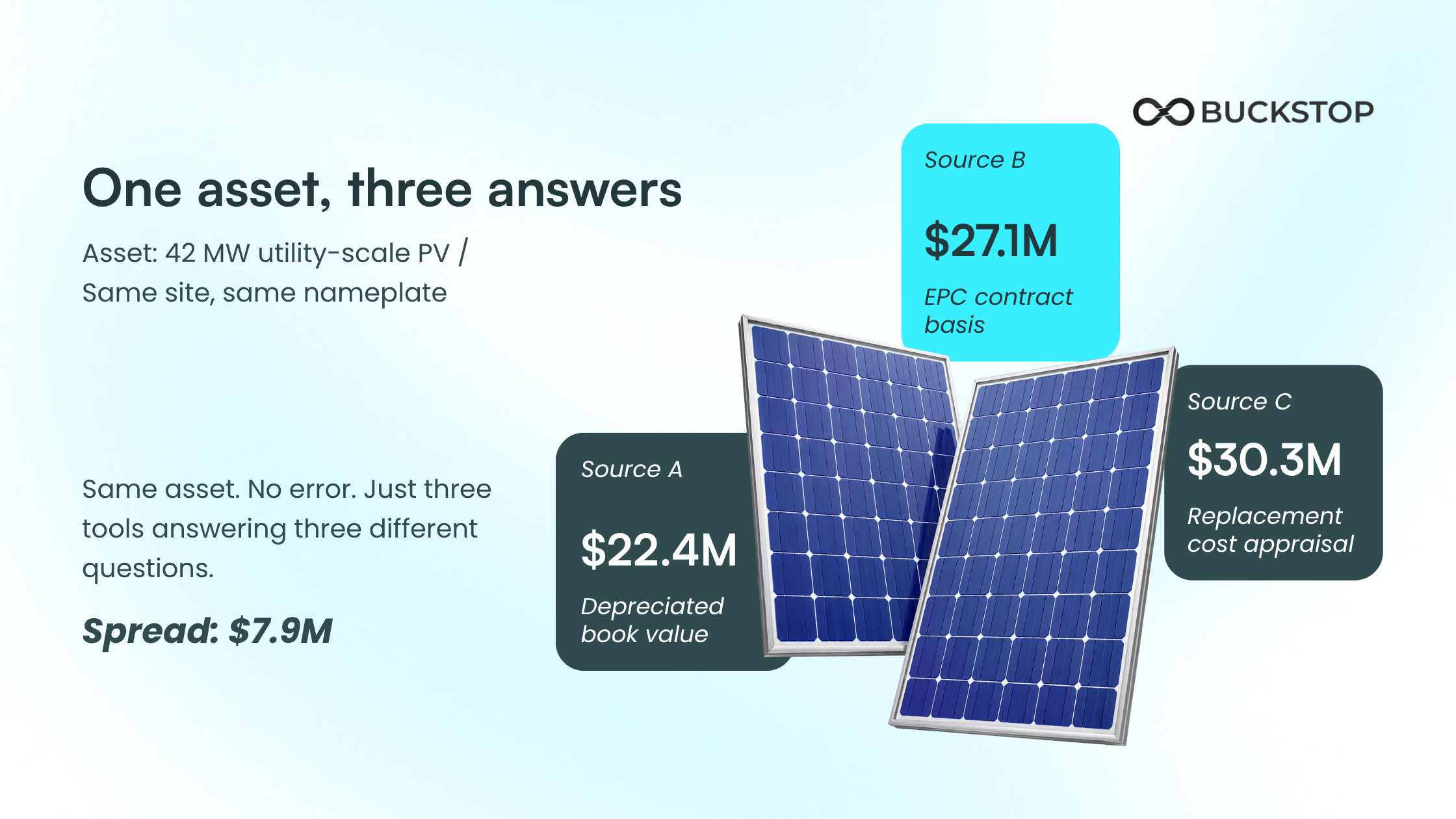
The reason this lands on your desk and not someone else's is structural. The owner sees the highest number and wants to insure to it. The underwriter sees the lowest and wants to price to that. Neither party is wrong inside their own frame, and neither is incentivized to reconcile the difference. You are the only person in the transaction who has to hold all three numbers at once and produce one figure that both sides will accept.
Stacking these and expecting a single number is like asking a thermometer, a scale and a stopwatch to agree on the weather. The industry has said as much out loud. At the kWh Analytics Renewable Energy Broker Council, a broker from Alliant described the market as facing a paradox of almost too much data and conflicting modeling, which leaves owners unsure which numbers to trust.
That is the working reality of renewable energy insurance valuation right now. The hard part is not producing a number. It is knowing which of several conflicting numbers is right, and being able to prove it.
Why old numbers go wrong faster than they used to
Even a well-built appraisal now decays quickly, because the two forces that set solar value are pulling in opposite directions at the same time.
On one side, deflation. Module prices sat near record lows around ten cents per watt through 2024, and utility-scale spot pricing dipped under twenty cents per watt in 2025. Solar hardware costs have fallen roughly 89 percent since 2010, and the national labs still project continued declines of two to four percent a year through the end of the decade. Every month, a replacement-cost number quietly gets more generous than the market.
On the other side, tariffs yank prices back up without warning. When new reciprocal duties and the final Southeast Asia anti-dumping rulings landed in April 2025, some suppliers raised US wholesale module prices by roughly a third almost overnight, closely tracking the new duty rates. An appraisal written the week before was suddenly wrong in the other direction.
The salvage side is moving too. Used and legacy module values fell about 30 percent from January 2024 levels, dropping under six cents per watt by late 2025, which reshapes the recovery and residual math baked into a total insured value. Add the technology turnover from older PERC modules to TOPCon, and equipment that anchored a 2021 valuation may be functionally obsolete today.
The practical effect for a total insured value is that both the ceiling and the floor are moving, and they are not moving together. Deflation quietly inflates a replacement-cost figure until it overstates what a rebuild would actually cost, which invites premium the client should not be paying. A tariff shock does the reverse and can leave an asset underinsured the day a duty takes effect. A number that was accurate at binding can be wrong in either direction by renewal, and nobody sends a memo when it happens.
A solar replacement cost appraisal written in 2021 is not a 2025 number. It is a historical artifact wearing a current date.
What underwriters are actually asking for
The renewable market has quietly shifted from price-taking to evidence-requiring. Underwriters are no longer content to receive a figure. They want to see the method behind it, and they are drawing hard lines where the method is thin.
The signal is explicit in the pricing of tax insurance, where valuation step-up has become a binding constraint: three in four underwriters will not cover a step-up above 25 percent. That is a market telling brokers, in numbers, that an unsupported valuation is now a coverage problem, not a paperwork one. Brokers who can assemble the data to differentiate a client in an underwriter's eyes sit in a genuinely unique position, as one AmWins broker put it to the same council.
In practice, demonstrated methodology is not complicated. It is a valuation that states which approach it used, names the inputs and the date they were pulled, and shows its work rather than asserting a total. An underwriter who can trace how you arrived at a figure has a reason to trust it, and a reason to differentiate your client from the next submission that arrived as a bare number with no lineage.
The translation for your desk is simple. The number is table stakes. The defensible insurance valuation, the one with a stated method, current inputs and a clear answer to "why this figure," is the actual product you are selling into the underwriting room. click here for more information.
What a broker can do right now
01. Audit the methodology, not just the number
Before you rely on any valuation, ask three questions of it. What question was this built to answer? Whose figure is it, and what was their incentive? When was it produced, and what has moved in the market since? A number without a method attached is a liability waiting for an underwriter to find it.
02. Know what each data source actually measures
Replacement cost is not market value. Market value is not book value. Book value is not probable maximum loss. When you can name what each source measures and what it ignores, you stop treating a conflict as an error and start treating it as information about which tool fits the question in front of you.
03. Know when to call for a third-party appraisal
Bring in an independent, transaction-aware valuation when the spread is material to the placement, when the last appraisal predates a tariff or pricing shift, or when the underwriter signals scrutiny. A defensible third-party number is cheaper than a mid-term dispute, a rejected insured value or a claim settled on the wrong basis.
Stop reconciling three numbers by hand.
The Solar Valuation Clarity Guide gives you the full framework: the four data sources you get handed, what each one really tells you, and a checklist to run before you accept any appraisal, from anyone. Every figure is sourced. No sales call.
Download the Solar Valuation Clarity Guide →

Grayson Shor
Before Buckstop, he led Amazon Worldwide Operations’ circular economy and battery sustainability program, supporting operations across 20 countries. Grayson also served as a U.S. diplomat and the U.S. State Department’s first Climate Security Analyst. His work today focuses on renewable energy asset intelligence, critical minerals, residual value, and building more efficient markets for the assets and materials powering the energy transition.
