
How to Build a Defensible Statement of Values (SOV) for Solar and BESS Portfolios
A Statement of Values (SOV) is one of the most important documents in renewable energy insurance underwriting. It tells insurers what assets are being insured, where they are located, and what values should be considered when structuring coverage. For solar and battery energy storage system (BESS) portfolios, however, preparing an accurate SOV is more complicated than listing equipment costs and applying a standard depreciation rate.
Renewable energy assets have different replacement costs, installation requirements, equipment lifecycles, and recovery values. A utility-scale solar facility commissioned eight years ago may have a significantly different replacement cost today. A BESS installation may require a different valuation approach depending on battery chemistry, system configuration, safety requirements, and available replacement technology.
When these differences are not properly documented, the resulting SOV can create problems during underwriting, renewals, and claims.A defensible Statement of Values for solar and BESS portfolios should therefore do more than provide an insured value. It should explain how that value was established, what assumptions support it, and how it can be verified.
This guide explains how to build an SOV that supports informed underwriting decisions, provides a reliable valuation record, and reduces uncertainty when losses occur.
What Is a Statement of Values in Renewable Energy Insurance?
A Statement of Values is a document submitted to an insurer or insurance broker that identifies the assets being insured and their declared values. In renewable energy insurance, an SOV typically includes information about individual solar facilities, battery energy storage installations, and the equipment and infrastructure associated with each location.
Insurers use this information to evaluate property exposures, determine appropriate coverage structures, establish limits, and assess portfolio concentration.
For a renewable energy portfolio, an SOV may include:
- Facility name, location, and operational status.
- Installed generation or storage capacity.
- Equipment types, manufacturers, and commissioning dates.
- Declared property values and their valuation basis.
- Replacement cost estimates for major equipment and infrastructure.
- Installation, construction, and commissioning costs.
- Supporting engineering documentation and valuation reports.
- Applicable deductibles, sublimits, and coverage considerations, where requested.
The distinction between an asset inventory and a defensible SOV is important.An asset inventory establishes what exists. A defensible SOV establishes what is being valued, how the value was calculated, and why the figure is appropriate for the intended insurance purpose. For insurers and brokers managing large renewable energy portfolios, that distinction can materially affect underwriting confidence.
Why Solar and BESS Portfolios Require a Different Valuation Approach
Traditional commercial property valuations often rely on relatively established replacement cost methodologies. Renewable energy assets introduce additional complexities because equipment technology, market pricing, and replacement requirements can change considerably throughout an asset's operating life.
1. Equipment prices change over time
Solar module prices, inverter costs, battery prices, and other equipment costs can fluctuate because of manufacturing capacity, supply chain conditions, tariffs, and technology developments. The original construction cost of a solar project may therefore differ substantially from the cost of replacing damaged equipment today. Using historical capital expenditure as the primary basis for an insurance SOV can create discrepancies between declared values and actual replacement requirements.
2. Replacement involves more than equipment procurement
Replacing damaged solar panels or battery units is rarely limited to purchasing equivalent equipment.
Depending on the loss, replacement may involve:
- Equipment removal and disposal.
- Transportation and logistics.
- Electrical and structural modifications.
- Engineering and design services.
- Installation labor and contractor mobilization.
- Testing, commissioning, and interconnection requirements.
- Permitting and code compliance.
These costs can represent a meaningful portion of the overall replacement expense.
3. Technology obsolescence affects replacement options
A solar module installed several years ago may no longer be manufactured. Similarly, an older battery system may use equipment, controls, or configurations that are no longer commercially available. In these situations, replacing damaged assets with identical equipment may not be possible. Valuation professionals must consider suitable replacement alternatives, compatibility requirements, and the costs associated with integrating newer equipment into existing infrastructure.
4. Different assets have different risk and valuation characteristics
Solar and BESS installations cannot always be valued using identical assumptions. Solar facilities generally include modules, inverters, mounting structures, transformers, collection systems, and associated infrastructure.
BESS installations may include battery racks, power conversion systems, thermal management equipment, fire detection and suppression systems, energy management controls, and specialized enclosures. Each component has distinct replacement requirements and cost drivers. A defensible renewable energy Statement of Values should reflect those differences rather than applying a single portfolio-wide cost assumption.
How to Build a Defensible Statement of Values for Solar and BESS Portfolios
Building an effective SOV requires a structured approach that connects asset information, replacement cost assumptions, engineering considerations, and valuation documentation. The following seven steps provide a practical framework.
Step 1: Establish a Complete Asset-Level Inventory
The first step is identifying exactly what the insurance policy is intended to cover. For portfolios containing multiple solar facilities or BESS installations, this requires a consistent asset inventory across every insured location.
At minimum, document the following information.
For solar portfolios, inventory records should distinguish between generation equipment and supporting infrastructure.For BESS portfolios, records should identify the battery system configuration, storage capacity, power rating, and major balance-of-system components.
This level of detail helps prevent two common problems: missing assets and inconsistent valuation assumptions across facilities. It also creates a more useful foundation for future insurance renewals and portfolio monitoring.
Step 2: Define the Appropriate Insurance Valuation Basis
Before assigning values, establish what the SOV is intended to represent. Different insurance policies may use different valuation provisions, including replacement cost, actual cash value, agreed value, or other contractually defined methods.
These approaches are not interchangeable.
Replacement Cost Value (RCV) generally considers the cost of repairing or replacing insured property in accordance with the policy's valuation provisions, without a deduction for depreciation when the applicable conditions are met.
Actual Cash Value (ACV) may account for depreciation or other factors, depending on the policy language and applicable jurisdiction.
Agreed Value arrangements depend on the specific terms negotiated between the insured and insurer.
For solar insurance valuation and BESS insurance valuation, the appropriate methodology must align with the actual policy wording. An SOV prepared using depreciated asset values may not adequately represent a policy requiring replacement cost coverage.
Likewise, using a full replacement cost estimate without identifying the underlying assumptions can create uncertainty about what the declared amount includes. The valuation basis should therefore be clearly stated and consistently applied across the portfolio.
Step 3: Calculate Replacement Costs Using Current Market Conditions
A defensible renewable energy replacement cost estimate should reflect the relevant cost environment as of the valuation date. Historical EPC contracts, original purchase orders, and construction budgets provide useful reference points, but they should not automatically determine current insured values.
For solar facilities, replacement cost analysis may consider:
- Solar modules and equivalent replacement technology.
- Inverters and associated power electronics.
- Mounting structures and tracking systems.
- Transformers and electrical equipment.
- Balance-of-system infrastructure.
- Installation labor and engineering services.
- Freight, mobilization, and commissioning.
For BESS installations, replacement cost analysis may consider:
- Battery modules, racks, and containers.
- Power conversion systems.
- Battery management systems.
- Thermal management and HVAC.
- Fire detection, suppression, and safety systems.
- Energy management and control systems.
- Electrical infrastructure and installation.
- Testing, commissioning, and integration.
These estimates should account for the practical realities of replacement, not simply the price of purchasing new equipment. For example, replacing a damaged battery enclosure may require additional electrical integration, safety testing, and system commissioning before the facility can resume operations.
Those costs should be evaluated when relevant to the insured property and policy coverage. A structured renewable energy TIV assessment process can help evaluate these replacement cost components and establish more supportable insured values. The objective is to establish a replacement cost estimate that can be explained and supported, rather than relying on a generic dollar-per-megawatt benchmark. Benchmarks can be useful for preliminary screening, but they should not replace asset-specific analysis when material differences exist.
Step 4: Account for Age, Condition, and Technology Changes
Solar and BESS assets operate over long periods, but their components do not necessarily age or depreciate at the same rate. Solar modules may remain operational for decades, while inverters and other electrical components may require replacement earlier.
Battery energy storage systems introduce additional considerations related to capacity degradation, operating cycles, thermal conditions, and system configuration.These factors matter when determining asset condition, estimating residual value, or applying a valuation method that incorporates depreciation.
However, physical depreciation should not automatically be deducted from replacement cost values when the insurance policy requires an undepreciated replacement cost basis. Instead, condition and technology information should be documented separately and incorporated where appropriate to the selected valuation methodology.
For example, an older solar facility may require newer module technology because the original model is unavailable. The replacement estimate should consider the cost of a suitable replacement and any necessary modifications, while accounting for applicable policy provisions concerning upgrades or betterment.
Similarly, replacing components within an older BESS installation may introduce compatibility requirements that affect the overall cost. Documenting these assumptions makes the valuation easier to review and defend.
Step 5: Separate Replacement Cost, Residual Value, and Recovery Value
One of the most important distinctions in renewable energy valuation is the difference between replacing an asset and recovering value from it after damage or retirement.
These figures serve different purposes.
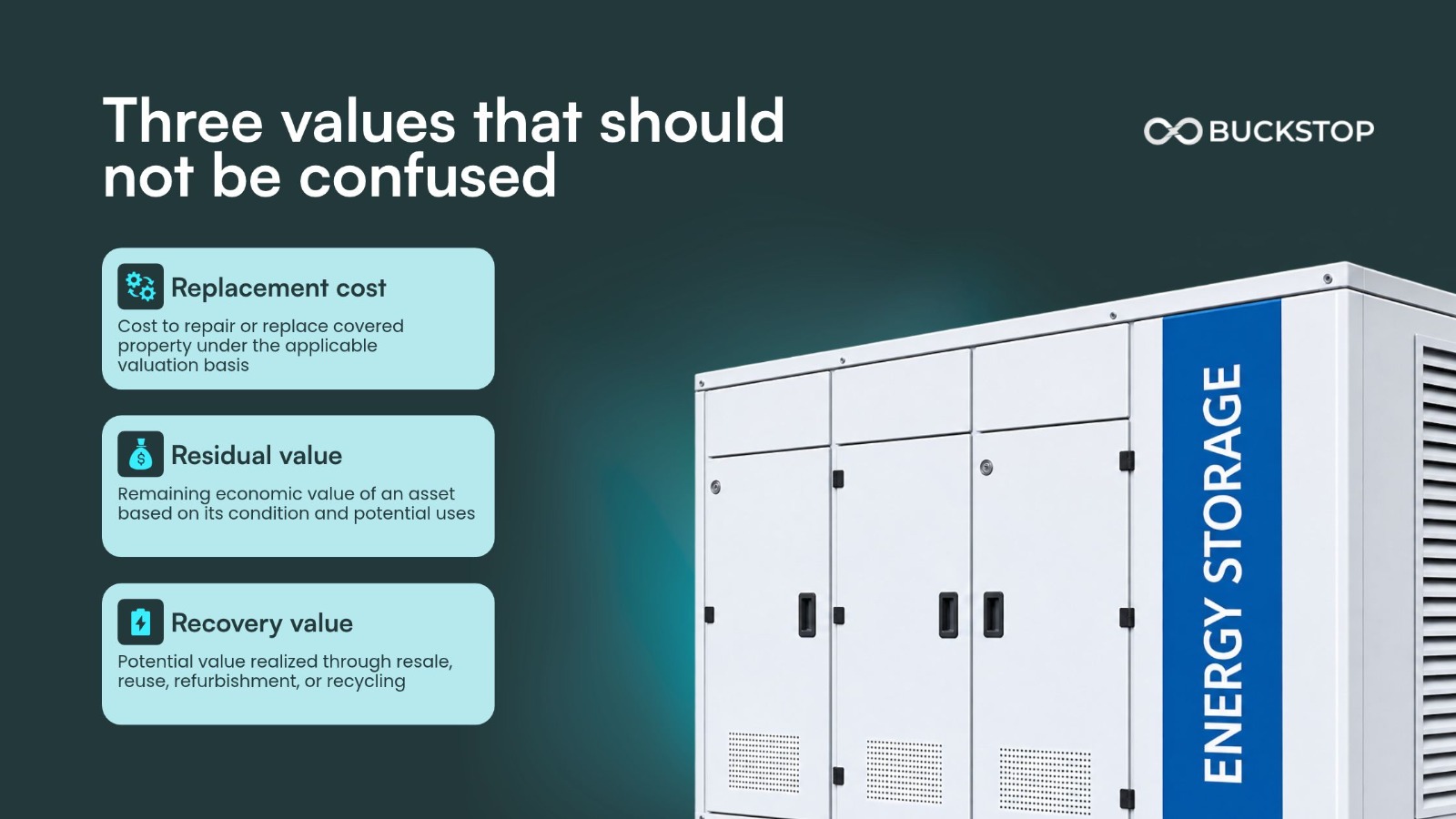
For example, a damaged solar inverter may have a replacement cost associated with purchasing and installing a new unit. The damaged inverter may also retain recoverable value through refurbishment, component resale, or material recycling. These values should not be combined or substituted without a clear methodological and contractual basis.
An insurance SOV generally focuses on the declared insured values required by the policy. Residual and recovery value assessments, supported by tools such as Buckstop's Residual Value Index, can provide additional intelligence for claims evaluation, salvage planning, and asset management.
Understanding these differences helps insurers, brokers, and asset owners avoid treating every valuation figure as though it represents the same economic outcome.
Step 6: Document the Assumptions Behind Every Material Valuation
A valuation is only as defensible as the evidence supporting it. An SOV containing a declared value without an identifiable calculation basis can be difficult to evaluate during underwriting or a claim.
For each material asset or asset category, supporting documentation should identify:
- The valuation date and effective date.
- The valuation methodology.
- Equipment specifications and quantities.
- Sources of market pricing and cost estimates.
- Installation and replacement assumptions.
- Included and excluded cost categories.
- Any limitations or data gaps.
- The rationale for material adjustments.
Where possible, maintain supporting documentation such as engineering reports, equipment schedules, construction records, vendor quotations, and independent valuation reports. This information helps establish a traceable relationship between the physical asset and its declared insurance value.
For complex renewable energy portfolios, third-party valuation support can also provide an independent basis for reviewing assumptions and identifying inconsistencies. Explore independent certified renewable energy appraisals to support documented valuation methodologies and more defensible asset values.
The goal is not simply to produce a number that appears reasonable. It is to produce a number that can be reconstructed, reviewed, and explained.
Step 7: Review and Update the SOV as the Portfolio Changes
A Statement of Values should not be treated as a document that is prepared once and reused indefinitely. Renewable energy portfolios change through equipment replacements, capacity expansions, repowering projects, acquisitions, and changing market conditions.
An SOV prepared several years earlier may no longer reflect the assets being insured or their current replacement requirements. At a minimum, review the SOV during each insurance renewal and whenever material portfolio changes occur.
Events that may warrant an updated valuation include:
- New solar or BESS assets entering the portfolio.
- Equipment replacements or major upgrades.
- Battery augmentation or repowering.
- Significant changes in equipment or installation costs.
- Asset acquisitions, disposals, or ownership changes.
- Major losses or repairs.
- Changes to insurance coverage requirements.
Maintaining a current SOV helps asset owners and insurance professionals identify valuation discrepancies before they become underwriting or claims issues. It also supports more consistent insurance reporting across growing portfolios.
Common Mistakes That Make Renewable Energy SOVs Difficult to Defend
Even experienced asset owners and insurance teams can encounter valuation problems when managing large or technically diverse portfolios.
The following mistakes are particularly important to avoid.
These issues can affect both the efficiency of underwriting and the quality of information available when a loss occurs.
How a Defensible SOV Supports Insurance Underwriting and Claims
A well-supported Statement of Values provides benefits beyond meeting an insurer's documentation requirements.
More informed underwriting decisions
Insurers need to understand both the property exposure and the basis of declared values. When an SOV contains consistent asset data and clearly documented valuation assumptions, underwriters can more effectively evaluate insured values, identify unusual exposures, and request clarification where necessary.
This does not guarantee a particular premium or coverage outcome, but it improves the quality of information available for underwriting.
Better visibility into portfolio concentration
Large solar and BESS portfolios may contain assets with significantly different values and risk characteristics. An asset-level SOV allows insurance professionals to assess values by facility, technology, location, or equipment category. This can support more informed decisions about limits, deductibles, and portfolio risk concentration.
Stronger documentation when claims occur
Following a loss, insurers and policyholders may need to establish the nature of the damaged property, the applicable valuation basis, and the cost of repair or replacement. A documented SOV provides a useful pre-loss reference. It can help identify the equipment involved, explain the original valuation assumptions, and support subsequent analysis.
However, the SOV does not independently determine the amount payable under an insurance policy. Claim outcomes remain subject to policy wording, loss circumstances, coverage conditions, and supporting evidence.
More consistent insurance renewals
When asset values are supported by a repeatable methodology, annual renewals become easier to manage. Instead of rebuilding the entire valuation from disconnected spreadsheets and historical records, asset owners can review material changes and update relevant assumptions. This creates a more consistent record across renewal periods.
Example: Building an SOV for a Mixed Solar and BESS Portfolio
Consider a hypothetical renewable energy owner with the following portfolio:
- A 150 MW utility-scale solar facility commissioned in 2018.
- A 100 MW solar facility commissioned in 2023.
- A 50 MW / 200 MWh BESS installation commissioned in 2024.
A simplified approach might apply a standard replacement cost per MW to the two solar facilities and a cost per MWh to the BESS installation. Although this may provide a preliminary estimate, it does not fully account for differences in equipment configuration, installation costs, or replacement requirements.
A more defensible approach would evaluate each facility separately.
Each facility would receive a documented valuation based on its actual equipment and the relevant insurance valuation methodology. The results could then be consolidated into a portfolio-level SOV while retaining the supporting asset-level detail.
This approach gives insurers a clearer view of the portfolio and makes it easier to explain material differences between facilities. It also reduces reliance on broad assumptions that may not hold across different asset types.
What Should You Look for in a Renewable Energy Insurance Valuation Partner?
Preparing a defensible SOV requires more than familiarity with insurance spreadsheets. The valuation provider should understand the technical and economic characteristics of renewable energy assets and be able to connect those characteristics to the relevant insurance valuation requirements.
When evaluating a solar insurance valuation or BESS insurance valuation partner, consider whether they can:
- Evaluate solar and battery energy storage assets at the equipment level.
- Develop replacement cost estimates using relevant market information.
- Account for equipment compatibility and technology changes.
- Distinguish replacement cost from residual and recovery value.
- Document methodologies, assumptions, and limitations.
- Support consistent valuations across multiple facilities.
- Provide reports that insurance brokers, underwriters, and asset owners can review and understand.
For large portfolios, repeatability is particularly important. A methodology that works for one solar facility should be capable of supporting consistent analysis across dozens of facilities while still accounting for asset-specific differences.
How Buckstop Supports Renewable Energy Insurance Valuation
Buckstop helps renewable energy stakeholders understand and document the value of solar, wind, and battery energy storage assets. By combining asset-level information, market intelligence, and technical valuation expertise, Buckstop supports defensible valuation decisions across the renewable energy asset lifecycle.
For insurance-related valuation requirements, Buckstop can help asset owners, insurers, and brokers develop a clearer understanding of asset values and the assumptions behind them.
Asset-specific valuation analysis
Buckstop evaluates renewable energy assets using relevant equipment characteristics, market information, and technical considerations rather than relying solely on broad industry averages.
Documented valuation methodologies
Through its valuation capabilities and technical expertise, Buckstop helps stakeholders establish valuation conclusions supported by identifiable methodologies and assumptions.
Replacement and recovery value intelligence
Buckstop's approach distinguishes the cost of replacing assets from their remaining economic and potential recovery value, supporting different decisions throughout the asset lifecycle.
Portfolio-level valuation visibility
For organizations managing multiple renewable energy facilities, Buckstop's Valuation Studio and Portfolio Monitoring capabilities support a more structured understanding of asset values across portfolios.
Whether preparing for an insurance renewal, reviewing declared values, or evaluating assets following a loss, the objective is the same: establish values that are supported by evidence and appropriate to the decision being made.
Need a More Defensible Valuation for Your Solar or BESS Portfolio?
Insurance decisions depend on understanding what renewable energy assets are worth and how those values were established. Buckstop helps asset owners, brokers, and insurers evaluate renewable energy assets using asset-level data, market intelligence, and technical expertise. Talk to Buckstop about your portfolio valuation requirements.
Download: The Renewable Energy Insurance Valuation Checklist
Before submitting your next Statement of Values, make sure your valuation documentation covers the information insurers need to review. Buckstop's The Renewable Energy Insurance Valuation Checklist: From Bind to Claim provides a practical resource for evaluating renewable energy insurance valuation documentation across the underwriting and claims lifecycle.
Download The Renewable Energy Insurance Valuation Checklist: From Bind to Claim
Frequently Asked Questions
What is a Statement of Values for solar and BESS portfolios?
A Statement of Values for solar and BESS portfolios is a document that identifies insured renewable energy assets and their declared values. It typically includes facility information, equipment details, capacity, valuation basis, and supporting cost estimates. Insurers use this information to evaluate property exposures and establish appropriate insurance coverage.
How do you calculate replacement cost for a solar facility?
Solar facility replacement cost is generally estimated by evaluating the cost of replacing covered equipment and infrastructure under the applicable insurance valuation basis. This may include modules, inverters, mounting structures, electrical systems, labor, engineering, transportation, and commissioning. The specific calculation should reflect the policy provisions and the facility's equipment configuration.
What should be included in a BESS insurance valuation?
A BESS insurance valuation should consider the battery modules, racks, enclosures, power conversion systems, battery management systems, thermal management, fire protection, electrical infrastructure, and applicable installation and commissioning costs. System age, configuration, equipment availability, and technology compatibility may also affect the analysis.
How often should a renewable energy Statement of Values be updated?
A renewable energy SOV should generally be reviewed at each insurance renewal and whenever material changes occur within the portfolio. These may include equipment replacements, repowering, new asset acquisitions, major repairs, or significant changes in replacement costs. The appropriate update frequency depends on portfolio complexity and insurer requirements.
What is the difference between replacement cost and actual cash value in renewable energy insurance?
Replacement cost generally refers to the cost of repairing or replacing insured property according to the policy's valuation provisions, without depreciation when the relevant conditions are satisfied. Actual cash value may reflect depreciation or other valuation considerations. The exact treatment depends on policy language and applicable law.
Can an inaccurate Statement of Values affect an insurance claim?
Yes. Inaccurate declared values can create coverage and claims complications, particularly when policies include valuation conditions, reporting requirements, or coinsurance provisions. The impact depends on the policy terms and the circumstances of the loss. Maintaining a well-supported SOV helps reduce uncertainty about the values originally declared.
Why should solar and BESS portfolios use independent valuation support?
Independent valuation support can provide additional technical expertise, documented methodologies, and objective review of asset values. This is particularly useful for portfolios containing different technologies, equipment generations, or complex replacement requirements. Independent analysis can also help identify inconsistencies in existing valuation records.
Final Thoughts: A Defensible SOV Starts With Defensible Asset Values
A Statement of Values is more than an insurance submission requirement. It is a foundational record of the assets being insured and the values assigned to them. For solar and BESS portfolios, defensibility depends on the quality of the underlying asset information, the relevance of replacement cost assumptions, and the documentation supporting each material valuation.
Historical construction costs, generic benchmarks, and incomplete inventories may provide convenient starting points, but they are not substitutes for a structured valuation methodology.
By maintaining accurate asset records, applying the appropriate insurance valuation basis, and updating values as conditions change, renewable energy stakeholders can improve underwriting transparency and strengthen the information available when claims arise. Buckstop helps renewable energy stakeholders make asset valuation decisions with greater confidence. For asset-specific solar and BESS valuation support, Let's Talk.

Grayson Shor
CPO & Co-FounderBefore Buckstop, he led Amazon Worldwide Operations’ circular economy and battery sustainability program, supporting operations across 20 countries. Grayson also served as a U.S. diplomat and the U.S. State Department’s first Climate Security Analyst. His work today focuses on renewable energy asset intelligence, critical minerals, residual value, and building more efficient markets for the assets and materials powering the energy transition.
