.avif)
Solar Insurance Valuation Checklist: 7 Things to Verify Before You Submit a TIV
Before you submit a total insured value on a solar asset, a sound solar insurance valuation should verify seven things: the equipment basis, the cost basis, market validation, condition and degradation, the salvage figure, regulatory documentation, and an auditable trail. If all seven hold, the total insured value holds with the carrier and in a claim. If any one is missing, that is usually where the dispute starts.
This is the checklist to run before a TIV submission or a renewal, written for brokers placing utility-scale and C&I solar. Use it on any appraisal you rely on, including your own.
Why solar TIVs fail after submission, not at it
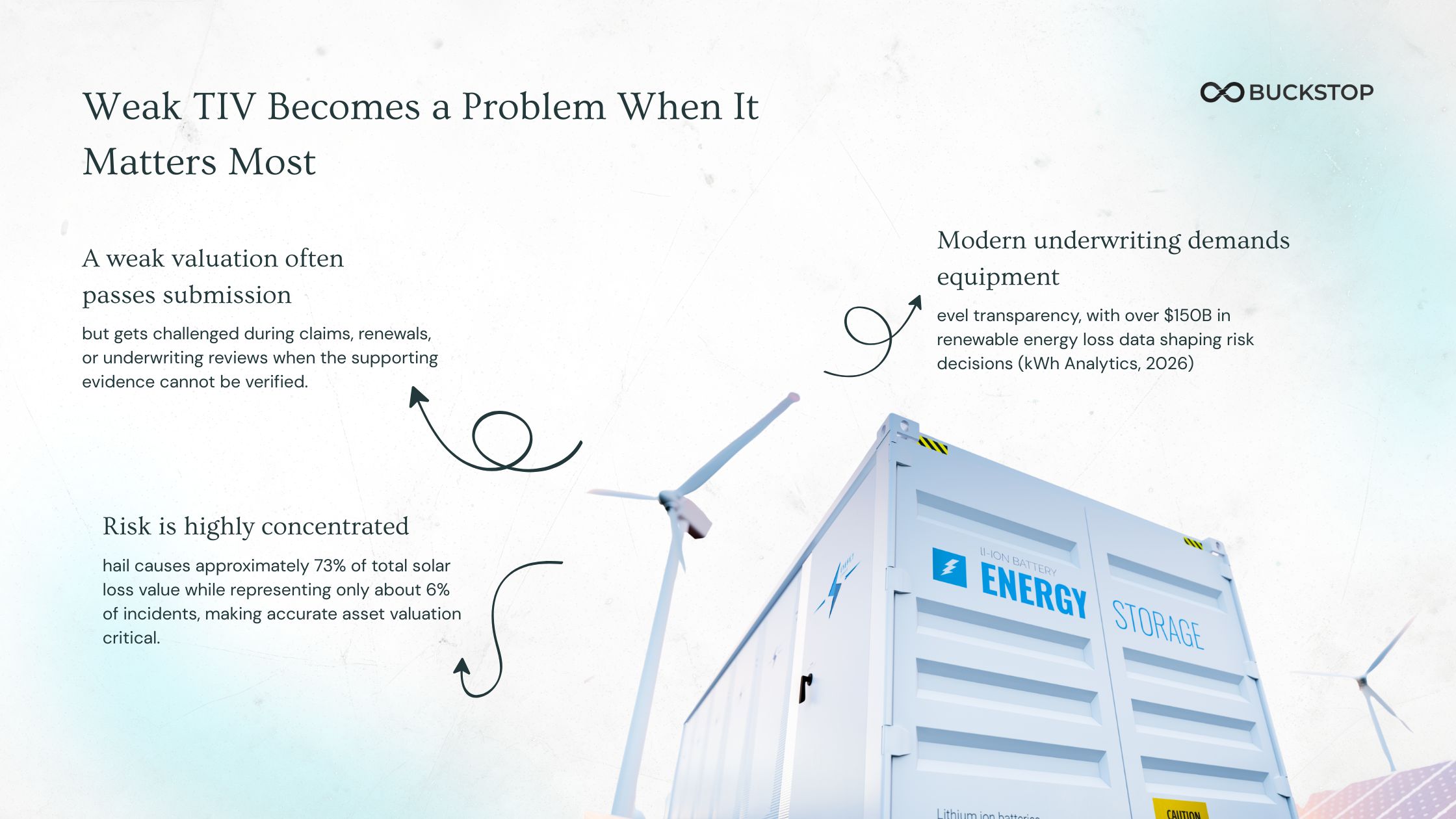
A weak TIV does not fail at submission. It fails later, at a claim, a carrier pushback, or a renewal, when the number is challenged and the basis cannot be shown. And challenges are getting sharper. The 2026 Solar Risk Assessment analyzed more than $150 billion in renewable energy loss data, and underwriting now leans heavily on equipment-level detail (kWh Analytics, 2026). Loss concentrates in specific places: hail alone accounts for roughly 73% of total solar losses by damage amount, from only about 6% of incidents (kWh Analytics).
A site-level, assumption-based solar asset valuation for insurance cannot speak to that, and carriers increasingly discount what they cannot verify. Most TIV disputes trace back to one of the seven checks below being skipped.
The 7-point solar insurance valuation checklist
1. Equipment basis: as-built, not nameplate.
Confirm the valuation reflects the equipment actually on site today, with manufacturer, model, vintage, and configuration, not the original specification. As-built and as-specified are often different assets once you account for substitutions and repowering. A solar TIV built on a nameplate spec sheet describes an asset that may not exist.
2. Cost basis: current market replacement cost.
Confirm the value uses current solar replacement cost for insurance, not original install or EPC cost, and verify the data source and its date. This is where stale numbers do the most damage. US module prices fell to roughly $0.07 to $0.09 per watt through 2024 and into early 2025, then jumped about 35% after the April 2025 tariffs (Wood Mackenzie, 2025; tariff pricing data, 2025). Any total insured value anchored to what the asset cost to build is wrong the day it is written.
3. Market validation.
Confirm the number has been checked against secondary-market pricing or real transactions, so it reflects what assets actually trade for rather than a modeled assumption. Validation is what turns an estimate into evidence. Without it, the figure is an internal assumption, and assumptions are what underwriters have learned to discount.
4. Condition and degradation.
Confirm degradation and physical condition are reflected. Modules lose output at roughly half a percent per year on average by widely cited industry research (NREL), and a fleet several years into its life does not carry its original value. A TIV that ignores condition misstates exposure in both directions.
5. Salvage and recovery value.
Confirm the salvage or recovery figure is grounded in current commodity and secondary-market conditions, not an assumed percentage. Scrap and salvage is the most frequently mispriced input in solar insurance. It moves with copper, aluminum, silver, and module prices, all of which can shift materially within a single quarter, so a fixed percentage carried over from an old study is almost always wrong.
6. Regulatory and documentation standard.
Confirm the valuation meets the documentation standard the placement requires, including USPAP alignment where a certified solar insurance appraisal is needed. The standard the number has to satisfy is set by the use case, whether that is underwriting, lending, or a regulatory filing, and a valuation built to the wrong standard will not be accepted.
7. Auditable trail.
Confirm the full methodology can be reconstructed. If the TIV is ever tested in a claim, the only question that matters is whether you can show exactly how the number was reached, input by input. A number you cannot reconstruct is a number you cannot defend, even when it is right.
How do you calculate TIV for a solar asset?
To calculate TIV for a solar asset, start from current market replacement cost for the equipment actually on site, then adjust for condition and degradation, and validate the result against real secondary-market activity. The total insured value should reflect what it would cost to replace the asset today, not the original install cost and not a depreciation schedule. The seven checks above are the way to confirm each input before the number becomes your submitted solar TIV.
What underwriters do with each check
Each point maps to something a carrier evaluates. The equipment and cost basis tell them whether the replacement cost is real. Market validation and condition tell them whether the number reflects today. The salvage figure feeds their own recovery math. The documentation standard and the auditable trail tell them whether the valuation will hold if the policy is ever tested. A solar asset valuation for insurance that satisfies all seven is one a carrier can accept without discounting it for uncertainty, which is what protects both your placement and your client.
Want the full framework behind this checklist or contact us about your next TIV submission., including what to bring to an underwriter when a value is challenged? Download The Solar Valuation Clarity Guide.
FAQ
What should a solar insurance valuation include?
A component-level equipment basis, current market replacement cost, validation against real market data, degradation and condition adjustment, a commodity-grounded salvage figure, documentation to the required standard such as USPAP, and an auditable methodology trail.
What is TIV for a solar asset?
Total insured value is the figure a solar asset is insured for. It should reflect current market replacement cost for the equipment actually on site, adjusted for condition, not the original install cost.
Why is salvage value hard to get right on solar?
Because scrap and salvage value moves with commodity prices for copper, aluminum, and silver, and with module pricing, all of which can shift materially within a quarter. An assumed salvage percentage anchored to an old study misprices it.
Does a solar insurance appraisal need to be USPAP-compliant?
For placements and contexts that require certified documentation, yes. USPAP alignment is what makes the appraisal acceptable for regulatory, lending, and certain underwriting purposes.

Grayson Shor
Before Buckstop, he led Amazon Worldwide Operations’ circular economy and battery sustainability program, supporting operations across 20 countries. Grayson also served as a U.S. diplomat and the U.S. State Department’s first Climate Security Analyst. His work today focuses on renewable energy asset intelligence, critical minerals, residual value, and building more efficient markets for the assets and materials powering the energy transition.
