.avif)

After the Loss: How Recovery and Salvage Value Change the Economics of a Renewable Energy Claim
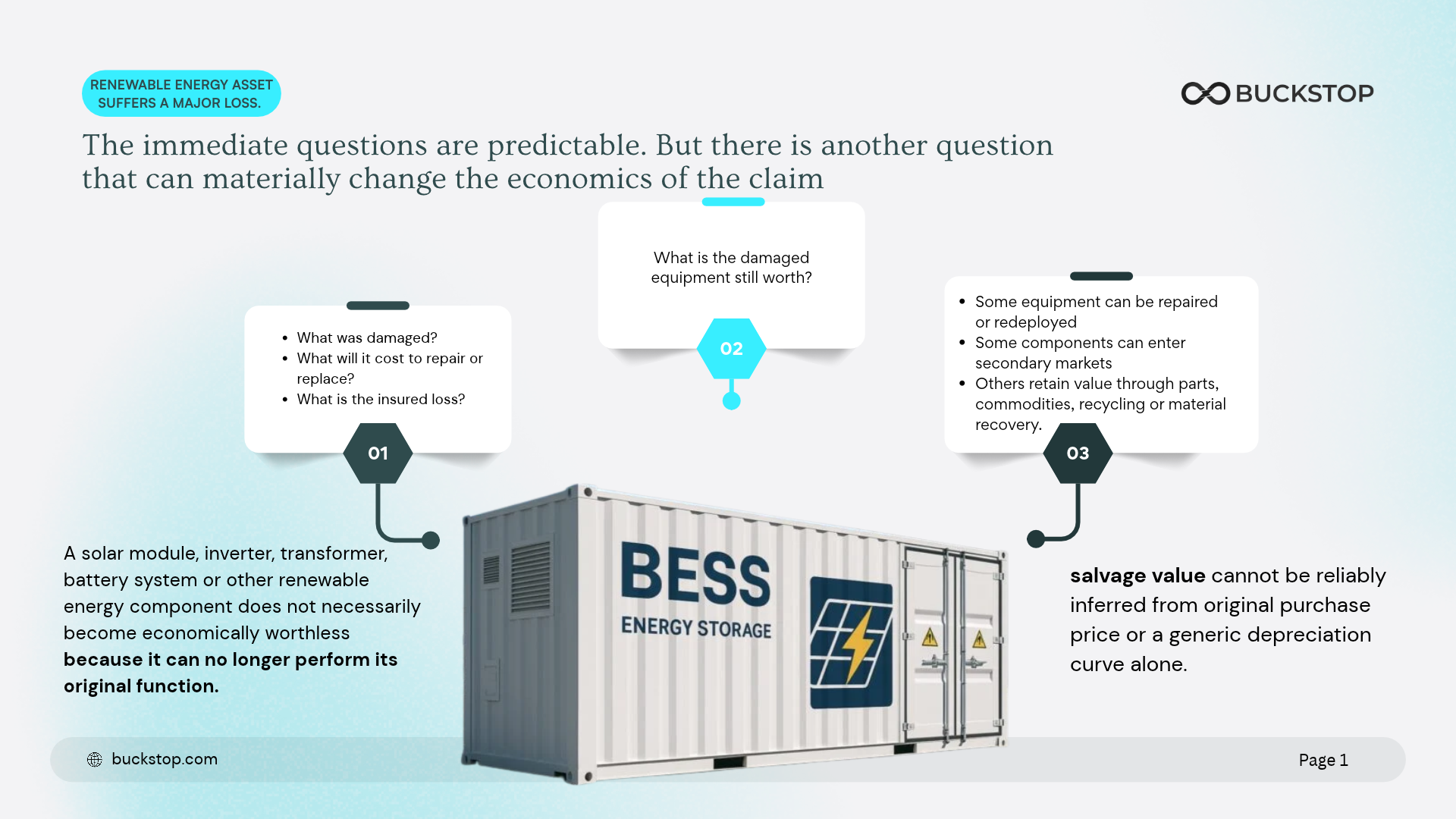
A renewable energy asset suffers a major loss. The immediate questions are predictable: What was damaged? What will it cost to repair or replace? What is the insured loss?
But there is another question that can materially change the economics of the claim: What is the damaged equipment still worth? A solar module, inverter, transformer, battery system or other renewable energy component does not necessarily become economically worthless because it can no longer perform its original function.
- Some equipment can be repaired
- Some can be redeployed
- Some components can enter secondary markets
- Others retain value through parts, commodities, recycling or material recovery.
That remaining economic value is where salvage value and recovery value enter the renewable energy claims process. And as renewable energy assets become a larger part of global insured infrastructure, understanding that value is becoming increasingly important.
What is salvage value in a renewable energy insurance claim?
In a renewable energy claim, salvage value is the economic value that remains in damaged equipment after a loss event.
That value can come from several places:
- resale of functioning or repairable equipment
- reuse of individual components
- secondary-market demand
- recovered metals and commodities
- recycling
- parts harvesting
- alternative applications for equipment that can no longer serve its original purpose
The important distinction is simple: Damage does not automatically mean worthless. A component may have lost substantial functional value while retaining measurable economic value. That distinction can affect the net economics of a claim.
The economics of a claim do not stop at replacement cost
Consider a simplified example. A renewable energy project suffers damage and the affected equipment has a replacement cost of $4 million. Looking only at replacement cost suggests a $4 million economic loss.
But suppose analysis of the damaged assets identifies: $450,000 in recoverable equipment value.
The economic picture is now different. The $450,000 does not make the loss disappear, nor does it automatically mean that an insurance payment is reduced by exactly that amount. Actual claim treatment depends on policy wording, ownership of salvage, expenses, deductibles and other claim-specific factors. But economically, there is still value sitting inside the damaged asset base. The question is whether anyone can identify it accurately.
Why renewable energy salvage is particularly difficult to value
Renewable energy assets create an unusual valuation problem. A solar project, wind farm or battery energy storage system is not a collection of interchangeable commodities.
Its equipment can differ by:
- manufacturer
- model
- technology
- age
- capacity
- operating history
- physical condition
- remaining useful life
- location
- warranty status
- secondary-market demand
Two apparently similar pieces of equipment can therefore have very different recovery outcomes. A damaged inverter with an active secondary market may retain meaningful value. An obsolete component with limited compatibility may have very little resale value but still contain recoverable materials. A solar module may no longer make economic sense for its original utility-scale installation while remaining technically usable elsewhere. That means salvage value cannot be reliably inferred from original purchase price or a generic depreciation curve alone.
It requires understanding what the asset is, what condition it is in and what economically viable recovery paths actually exist.
Recovery value is broader than scrap value
One of the easiest mistakes in post-loss renewable energy valuation is treating recovery as a scrap exercise. Scrap is only one possible outcome. A damaged asset can potentially move through several recovery channels:
1. Reuse
Equipment that remains operational may be redeployed rather than discarded.
2. Repair and resale
Certain components can be repaired or refurbished and returned to a secondary market.
3. Parts harvesting
An asset that is no longer economically repairable as a complete unit may still contain usable components.
4. Commodity recovery
Copper, aluminum, steel, silver and other materials can contribute to recovery value.
5. Recycling
Where reuse or resale is not viable, recycling may provide another recovery route.
The highest-value path is not necessarily the most obvious one. That is why the question should not simply be: “What is the scrap value?” It should be: “What is the highest economically viable recovery pathway for this asset?”
Solar illustrates the problem particularly well
Solar equipment demonstrates why post-loss valuation is becoming more complicated. Photovoltaic modules contain potentially valuable materials including silicon, silver and copper. At the same time, recovering those materials is not necessarily inexpensive.
Research from the National Laboratory of the Rockies has highlighted the economic challenges associated with PV recycling. Collection, transportation, sorting and processing costs can exceed the value of recovered materials. This creates an important distinction for claims professionals:
Gross material value is not the same as net recovery value. If an asset contains $100,000 of theoretically recoverable material but costs $80,000 to transport, process and sell, the economic recovery opportunity looks very different. A defensible recovery valuation therefore needs to consider both sides of the equation. Potential recovery proceeds minus the costs required to realize them.
Secondary markets add another layer
The secondary market for renewable energy equipment can create recovery opportunities beyond recycling. NREL research into circularity in photovoltaic systems has examined repair, reuse and secondary-market pathways as alternatives to immediate disposal.
For claims professionals, this introduces another valuation question. What is damaged equipment worth today, in its actual condition, to an actual buyer? That cannot always be answered with a static depreciation schedule.
Secondary-market value can depend on:
- equipment availability
- replacement lead times
- compatibility with existing projects
- manufacturer support
- technology obsolescence
- regional demand
- logistics
- equipment condition
The market may therefore value an asset differently from an accounting model.
Salvage can affect more than the final claim number
Understanding recovery value early can influence several decisions after a renewable energy loss.
Repair vs. replace
If damaged equipment retains substantial value through repair, reuse or resale, the economics of replacement can change.
Total-loss decisions
A technically damaged asset may still contain enough recoverable value to materially affect the economics of declaring it a total loss.
Disposition strategy
Knowing which components should be resold, dismantled, recycled or scrapped can improve recovery outcomes.
Reserve accuracy
Better visibility into potential recoveries can provide insurers with more information when evaluating the ultimate economics of a loss.
Settlement discussions
A documented view of remaining asset value gives insurers, insureds and other stakeholders a more concrete basis for discussing the financial consequences of the loss.
Timing matters
Recovery value is not necessarily static. Sometimes secondary-market demand changes, commodity prices move, equipment becomes obsolete, storage costs accumulate, weather exposure can cause additional deterioration and transportation and processing economics change.
A component worth recovering immediately after a loss may become less attractive after months of storage and uncertainty. This makes time-to-valuation an economic variable in the claim itself. The longer the industry takes to determine what damaged equipment is worth, the greater the possibility that some of that recoverable value changes or disappears.
The renewable energy industry is heading toward a much larger recovery problem
This issue will become harder to ignore as renewable infrastructure matures. The National Renewable Energy Laboratory has estimated that retired PV module volumes could become enormous over the coming decades, while insurers and reinsurers are increasingly examining the risks associated with renewable energy recycling and disposal.
Swiss Re has similarly highlighted the growing insurance implications surrounding end-of-life solar panels, wind turbine components, batteries and other energy infrastructure. For insurers, this means salvage is becoming more than a claims administration task. It is becoming an asset intelligence problem.
What should a renewable energy salvage valuation actually answer?
A useful post-loss valuation should make several things clear:
What exactly is the equipment?
Manufacturer, model, specifications, age, location and operating characteristics.
What condition is it in?
Operational, damaged, repairable, partially reusable or end-of-life.
What recovery pathways exist?
Resale, refurbishment, reuse, parts harvesting, recycling or commodity recovery.
What does the market support?
Actual market evidence should inform the valuation wherever possible.
What will recovery cost?
Transportation, dismantling, storage, processing and transaction costs matter.
What is the resulting net recovery value?
Ultimately, the relevant number is not a theoretical material value.
It is the economically realizable value remaining after the loss.
From claims adjustment to asset intelligence
Renewable energy claims are becoming more complex because renewable assets themselves are becoming more complex. Replacement cost tells one side of the story.
Remaining economic value tells another. At Buckstop, we believe the industry needs better visibility into both.
Buckstop's Residual Value Intelligence is built to help insurers, asset owners, lenders and other stakeholders understand the economic value embedded in renewable energy equipment across its lifecycle, including when assets are damaged, decommissioned or approaching disposition. Contact Buckstop to understand the economic value that may still be recovered after a renewable energy loss.
Because after a loss, the most important valuation question is not always: “What will it cost to replace?” Sometimes it is: “What is still worth recovering?” And the difference between those two questions can materially change the economics of a renewable energy claim.

Alexander Olesen
A serial entrepreneur and Forbes 30 Under 30 honoree, Alexander previously founded Babylon Micro-Farms and grew the company across five countries. Today, his work focuses on bringing greater transparency to renewable energy asset values, residual value, and recovery markets. He is a University of Virginia graduate, patent holder, and TEDx speaker.
