.avif)

From Acquisition to Exit: How Renewable Energy Asset Values Change Across the Project Lifecycle
A renewable energy project may operate for decades, but its value does not follow a straight downward line from original CapEx to zero. Consider a solar project acquired shortly after commissioning.
At acquisition, investors may focus on the current market value of the installed equipment and the economics supporting the transaction. Several years later, the same project may need to be valued for refinancing. Equipment has aged, replacement pricing has changed, technology has advanced, and secondary-market demand may look different.
At insurance renewal, the relevant question changes again: What would it cost to replace the equipment today? Later, the owner may consider repowering, selling the project, or decommissioning it. Now remaining useful life, resale demand, recoverable materials, removal costs, and alternative recovery pathways become increasingly important.
The asset is the same. The valuation method and actual value are not.
Understanding how renewable energy asset values change across the project lifecycle is therefore essential for investors, lenders, insurers, asset owners, and portfolio managers making decisions about capital throughout an asset's life.
Renewable Energy Asset Value Is Not One Number
One of the biggest mistakes in renewable energy asset management is treating "asset value" as a single figure. A solar, wind, or battery storage project can have several legitimate values at the same point in time.
- Replacement Cost New asks what comparable equipment would cost to replace under current market conditions
- Fair Market Value asks what the existing equipment is worth today based on factors such as age, specifications, condition, remaining useful life, and market demand
- Salvage Value asks what economic value could ultimately be recovered through resale, reuse, recycling, material recovery, or other disposition pathways, after applicable costs.
Buckstop applies these different valuation perspectives because they answer fundamentally different financial questions. The useful valuation therefore depends on where the project is in its lifecycle and what decision is being made.
Stage 1: Acquisition and Development
The valuation question: What exactly are we buying?
At acquisition, investors naturally focus on project-level economics: contracted revenues, expected cash flows, operating costs, financing structure, and expected returns. But underneath the financial model sits a portfolio of physical equipment.
For solar projects that includes the full list of equipment, such as:
- Modules
- Inverters
- Transformers
- Racking
- Cabling
- Electrical infrastructure
For BESS, the equipment profile becomes even more complex, including cells, modules, racks, containers, power conversion systems, transformers, thermal management systems, controls, and related infrastructure. Understanding equipment-level value can provide another layer of diligence around an acquisition. Instead of relying solely on original procurement cost, investors can ask:
What are these assets actually worth in today's market?
That assessment may consider manufacturer, model, technology, capacity, vintage, condition, location, current equipment pricing, secondary-market demand, and potential recovery pathways. Buckstop's Residual Value Index, for example, incorporates asset-level characteristics alongside secondary-market transactions and recycling and material recovery pricing rather than relying solely on generalized depreciation assumptions.
Why this matters during acquisition
Two projects with similar nameplate capacities do not necessarily contain physical assets with equivalent economic value.
One portfolio may contain equipment with:
- stronger secondary-market demand,
- readily available replacement components,
- greater remaining useful life,
- better recovery economics,
- or more valuable raw materials that can be recycled.
Another may contain older or less marketable equipment. Those differences can become increasingly important after acquisition.
Stage 2: Commissioning and Early Operations
The valuation question: What would this asset cost to replace today?
Once the project becomes operational, insurance and risk management become more prominent. This is where Replacement Cost New becomes particularly relevant.
The original EPC cost is historical. Replacement cost is current.
Those numbers can diverge because equipment prices, labor, freight, technology, supply chains, and component availability change after construction. A solar project commissioned several years ago therefore should not automatically carry forward its original equipment cost as today's replacement value. The same issue applies to BESS.
Battery equipment markets can move while the installed system is simultaneously degrading, meaning the physical asset and the external market around it are changing at the same time.
For asset owners, this creates an important distinction:
Original CapEx tells you what the project cost. Replacement Cost New tells you what comparable equipment may cost now.
Those are not interchangeable numbers.
Stage 3: Mature Operations
The valuation question: What is the equipment worth now?
Once a renewable energy project has operated for several years, valuation becomes more complicated. Age matters, but age alone does not determine value. Consider two solar modules installed in the same year.
One may be operating normally in a project with strong maintenance history and continued market demand for comparable equipment. Another may have suffered damage or belong to a technology generation with little secondary-market demand. They have the same chronological age. They may not have the same market value.
For BESS, the distinction becomes even more pronounced. Battery value can be influenced by calendar aging, cycling, temperature, operating profile, state of health, augmentation history, chemistry, and remaining usable capacity. Buckstop's BESS valuation methodology therefore treats depreciation and current economic valuation as different concepts.
Asset value starts becoming increasingly component-specific
A renewable energy project should not necessarily be viewed as one uniformly depreciating asset. Different components may:
- age at different rates,
- be replaced at different times,
- retain different secondary-market demand,
- have different remaining useful lives,
- and follow different end-of-life pathways.
An inverter may have a different value trajectory from a module. A transformer may have a different secondary market from a battery rack. A battery added during an upgrade may have a completely different vintage from the original system. This is why component-level asset intelligence becomes increasingly valuable as a portfolio matures.
Stage 4: Refinancing
The valuation question: What value supports the capital structure today?
A refinancing event forces another reassessment of value. The lender is not financing the same project that existed at commissioning.
It is financing the asset that exists today. That means historical project cost may provide context, but it does not automatically answer questions around current collateral or recovery value.
A lender may need visibility into:
- Current equipment value
- Remaining useful life
- Equipment condition
- Technology vintage
- Secondary-market demand
- Downside recovery scenarios
- Residual value
- Decommissioning exposure
This is where current Fair Market Value and Residual Value can become particularly useful. A valuation that was reasonable at acquisition may no longer represent the asset several years later.
Stage 5: Repowering and Upgrades
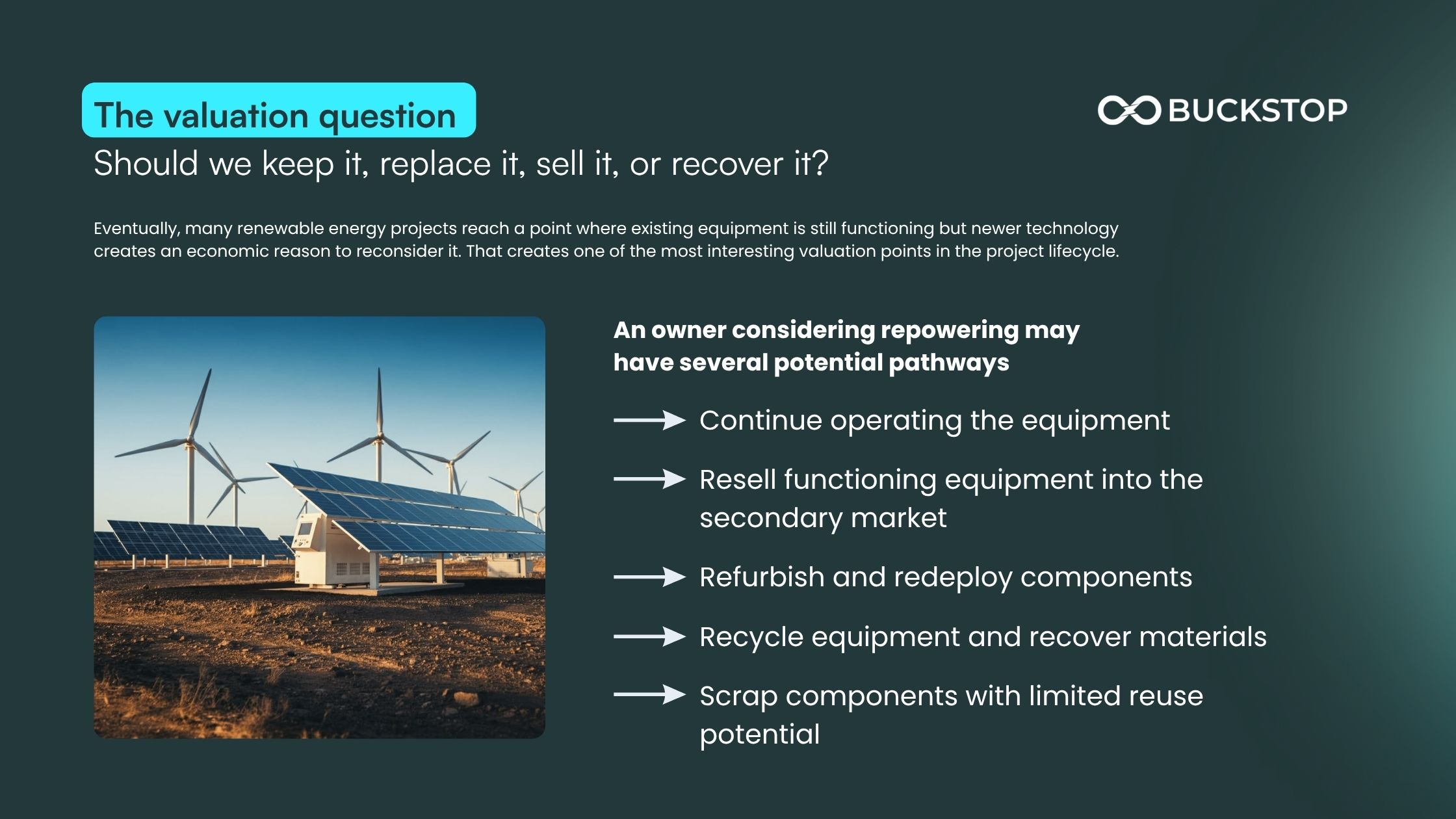
The valuation question: Should we keep it, replace it, sell it, or recover it?
Eventually, many renewable energy projects reach a point where existing equipment is still functioning but newer technology creates an economic reason to reconsider it. That creates one of the most interesting valuation points in the project lifecycle.
An owner considering repowering may have several potential pathways:
- Continue operating the equipment
- Resell functioning equipment into the secondary market
- Refurbish and redeploy components
- Recycle equipment and recover materials
- Scrap components with limited reuse potential.
The economically attractive path depends partly on what the existing equipment is worth under each scenario. This means residual value should not automatically be treated as synonymous with scrap value.
Buckstop's Residual Value Index tracks observed market outcomes across resale, recycling, and scrap markets, incorporating factors such as manufacturer, age, condition, location, and configuration.
For BESS, augmentation introduces another layer. A battery project may contain original modules alongside newer capacity added years later. Treating the entire system as a single asset with one age and one depreciation rate can obscure meaningful differences between equipment vintages.
Stage 6: Portfolio Sale or Asset Exit
The valuation question: What is the portfolio worth to the market today?
When an owner prepares to sell a project or portfolio, the valuation question changes again. The buyer inherits more than future project cash flows. They also inherit physical equipment with:
- remaining useful life,
- replacement requirements,
- maintenance obligations,
- secondary-market value,
- repowering potential,
- and eventual decommissioning exposure.
This makes current equipment intelligence relevant to both sides of the transaction. For the seller, it can help support assumptions about the value remaining within the portfolio. For the buyer, it can provide another diligence layer around what is actually being acquired.
Instead of simply asking: What did these assets cost?
The transaction can ask: What are these assets worth under today's market conditions?
Stage 7: Decommissioning and End-of-Life
The valuation question: What value remains after operations end?
At the end of the project lifecycle, valuation shifts from operating economics toward recovery economics. But end-of-life does not necessarily mean zero value. Renewable energy assets can contain recoverable value through:
- reusable equipment
- secondary-market resale
- refurbishment
- copper
- aluminum
- steel
- silver and other materials
- battery materials
- transformers
- cabling
- and other components
The relevant question becomes: What value can be recovered after accounting for recovery costs?
That distinction matters. Gross material value is not the same as net salvage value.
Decommissioning, transportation, dismantling, processing, recycling, disposal, labor, and site-specific logistics can all affect the ultimate recovery economics. The uncertainty can be substantial.
Buckstop reports that its analysis of a randomized sample of U.S. utility-scale solar decommissioning bonds found salvage estimates ranging from roughly $3,000/MW to $198,000/MW for similar assets. That spread illustrates why residual value assumptions can materially change financial decisions.
The Renewable Energy Asset Value Lifecycle
The progression can be simplified like this:
The important point is that the relevant value changes as the financial decision changes.
Why Straight-Line Depreciation Does Not Tell the Whole Story
It is tempting to model renewable energy equipment using a straightforward equation: Original Cost → Annual Depreciation → Current Value
That may serve an accounting purpose. It does not necessarily represent current economic value. Real asset value is affected by variables that do not move in a straight line.
- Equipment prices can fall
- Commodity prices can rise
- Technology can become obsolete
- Secondary-market demand can strengthen
- Equipment can be damaged or replaced
- BESS capacity can degrade
- A project can be augmented
- Repowering can create demand for used equipment
- Recovery and recycling markets can change.
As a result, the economic value of a renewable energy asset can move differently from its accounting depreciation schedule.
Asset Valuation Should Be a Lifecycle Process, Not a Transaction Event
Renewable energy assets are frequently valued when a specific transaction forces the question: An acquisition, an insurance renewal, refinancing, sale, or a decommissioning study.
But the asset changes between those events, and so does the market. For portfolios exposed to changing equipment prices, technology, secondary markets, and commodity values, treating valuation as current asset intelligence can provide a more useful view than relying on a point-in-time study completed years earlier.
Potential revaluation triggers include:
- Acquisition or portfolio sale
- Insurance renewal
- Refinancing
- Major equipment replacement
- BESS augmentation
- Repowering
- Material equipment-price movements
- Changes in secondary-market demand
- Commodity-price movements
- Decommissioning planning
The question is therefore not simply "When was this asset last valued?"
It is: "Has anything changed that could materially change what this asset is worth?"
How Buckstop Tracks Value Across the Renewable Energy Asset Lifecycle
Buckstop is designed around the idea that renewable energy asset value changes throughout the project lifecycle.
The Valuation Studio turns equipment-level asset data into current Replacement Cost New, Market Value, and Salvage Value, rather than relying solely on original project CapEx or static depreciation assumptions. Buckstop states that its platform supports quarterly repricing, helping users monitor changing valuation conditions over time. Behind that sits Buckstop's Residual Value Index, which uses secondary-market transactions, recycling and material recovery pricing, asset characteristics, and location-specific factors to benchmark residual value across renewable energy equipment.
That allows the valuation framework to follow the asset through different decisions: Acquire → Insure → Operate → Refinance → Repower → Sell → Decommission
Rather than carrying the same historical assumption from one stage to another, owners, investors, lenders, and insurers can evaluate the asset against the market that exists when the decision is actually being made. Ready to understand your asset value? Get Your First Valuation Free with Buckstop.
Know What the Asset Is Worth Before the Next Decision Depends on It
A renewable energy asset does not have one value for its entire life.
- At acquisition, the question may be market value
- At insurance renewal, replacement cost matters
- During refinancing, lenders may need current collateral and residual value
- At repowering, the question becomes whether equipment should continue operating, be resold, refurbished, recycled, or replaced
- At decommissioning, recoverable value can directly affect net retirement economics
- The asset changes
- The market changes.
The valuation should change with them.
Buckstop's Valuation Studio provides current Replacement Cost New, Market Value, and Salvage Value for solar, BESS, and renewable energy equipment, backed by market intelligence designed to support decisions throughout the asset lifecycle.
Explore Buckstop Valuation Studio: Renewable Energy Valuation Studio
Frequently Asked Questions
How does the value of a renewable energy asset change over time?
Renewable energy asset value changes as equipment ages, technology evolves, market pricing moves, condition changes, secondary-market demand develops, and remaining useful life declines. Different stages of the project lifecycle may also require different valuation perspectives, including replacement cost, fair market value, and salvage value.
How should a solar project be valued during acquisition?
Acquisition analysis can include current fair market value of installed equipment alongside traditional project-level financial analysis. Equipment specifications, manufacturer, vintage, condition, current market pricing, remaining useful life, secondary-market demand, and residual value can all influence the physical asset valuation.
When should renewable energy assets be revalued?
Revaluation can be particularly relevant around acquisitions, insurance renewals, refinancing, portfolio sales, equipment replacements, repowering, BESS augmentation, major market-price changes, and decommissioning planning.
What is renewable energy residual value?
Residual value represents the economic value remaining in renewable energy equipment as it ages. Depending on the asset and its condition, value may be realized through continued use, resale, refurbishment, redeployment, recycling, material recovery, or scrap pathways.
Is renewable energy asset depreciation the same as asset valuation?
No. Depreciation is generally an accounting mechanism for allocating asset cost over time. Asset valuation seeks to determine current economic value based on factors such as equipment condition, market pricing, remaining useful life, secondary-market demand, and recovery economics.
What happens to solar equipment value during repowering?
Equipment removed during repowering does not necessarily have zero value. Depending on its age, condition, specifications, remaining useful life, location, and market demand, equipment may have value through resale, refurbishment, redeployment, recycling, or material recovery.
What is the difference between replacement cost and residual value?
Replacement Cost New estimates what comparable equipment would cost to replace today. Residual value focuses on the economic value remaining in existing equipment, including potential resale, reuse, recycling, and material recovery pathways. The appropriate metric depends on the financial decision being made.