

Why Renewable Energy Insurance Valuation Is Moving From Annual Appraisals to Continuous Market Intelligence
A renewable energy asset's insured value may stay the same for 12 months. The market conditions determining that value rarely do.
Solar panels become cheaper. Replacement equipment changes. Labor costs fluctuate. Supply chains shift. Project configurations evolve. Yet across renewable energy insurance portfolios, insured values are often established at a single point in time and carried forward until the next scheduled review.
This creates a fundamental challenge for insurers, brokers, and asset owners: How reliable is an insurance valuation when the market behind it keeps moving?
Annual appraisals have long provided a structured approach to establishing asset values. They remain important, particularly when independent, certified valuations are required. But as renewable energy portfolios expand and replacement economics become more complex, periodic assessments alone may not provide the visibility needed for timely underwriting and risk decisions.
The industry needs more than an updated number once a year. It needs ongoing intelligence into what renewable energy assets are worth, what drives those values, and when those values warrant reconsideration.
The Problem With Point-in-Time Renewable Energy Valuations
Traditional insurance valuation generally follows a familiar process. An asset owner submits equipment and project information, an appraisal or valuation is conducted, and the resulting figures inform insurance schedules, underwriting discussions, and coverage decisions.
The values may then remain unchanged until the next renewal, major asset modification, or formal reassessment. The limitation is not necessarily the quality of the original appraisal. It is the assumption that a valuation established at one point in time will remain appropriate throughout the policy period. Consider a commercial solar installation valued at $15 million for insurance purposes.
Six months later, several underlying conditions may have changed:
- Replacement module pricing may have declined.
- Inverter availability or specifications may have changed.
- Installation labor costs may have increased.
- Freight and equipment lead times may have shifted.
- The facility may have undergone equipment replacements or capacity modifications.
The original $15 million valuation might still be reasonable. It might also require adjustment. Without updated market information, insurers and asset owners have limited evidence to determine which is true.
A valuation does not become inaccurate simply because it is old. It becomes less defensible when material changes occur and nobody evaluates their impact.
Why Renewable Energy Assets Are Particularly Difficult to Value
Renewable energy assets present valuation challenges that conventional property insurance methodologies do not always capture adequately.
1. Equipment Prices and Replacement Costs Do Not Move Together
The market price of solar modules is only one component of a renewable energy project's replacement cost. A complete replacement may involve modules, inverters, mounting systems, electrical infrastructure, engineering, transportation, installation labor, permitting, and commissioning.
A decline in module prices does not automatically produce an equivalent reduction in total replacement costs. Likewise, a project may become more expensive to replace even when certain equipment components become cheaper. For insurers, this distinction matters because replacement cost is not the same as equipment purchase price, resale value, or depreciated book value.
Each serves a different financial purpose.
2. Renewable Energy Portfolios Contain Significant Asset Variability
Two solar installations with identical nameplate capacities may have materially different replacement costs.
Differences can arise from:
- Geographic location and local labor markets
- Ground-mounted versus rooftop configurations
- Equipment manufacturers and specifications
- Installation age and technology generation
- Electrical and interconnection infrastructure
- Site accessibility and replacement complexity
Applying the same dollar-per-watt assumption across an entire portfolio can conceal meaningful differences between individual sites. A standardized rate may be useful for preliminary estimates, but it should not replace asset-specific analysis when material insurance decisions depend on the result.
3. Technology Evolution Changes Replacement Assumptions
Renewable energy equipment does not remain commercially static.
As manufacturers introduce new technologies and discontinue older products, replacing damaged equipment may involve different specifications, compatibility considerations, and procurement requirements. An insurer evaluating a loss on an older solar installation must consider more than the original purchase price. The relevant question is what it would reasonably cost to restore the insured property under the applicable policy terms and current market conditions.
That requires an understanding of both the original asset and the replacement market.
4. Portfolio Data Is Frequently Inconsistent
Renewable energy insurance portfolios often contain information assembled from multiple sources, including statements of values (SOVs), engineering reports, asset registers, lender documentation, and previous appraisals. These records may use different valuation dates, methodologies, asset classifications, or equipment assumptions. The resulting inconsistencies can make it difficult to compare insured values across sites. For large portfolios, identifying those discrepancies manually can be a substantial operational challenge.
Also check: Is your renewable energy collateral valuation credit committee-ready? 12 questions to answer before your memo goes to committee, and the red flags that could send your deal back for another round.
What Happens When Insured Values Fall Behind Market Reality?
The consequences extend beyond whether an insurance schedule contains the correct number. Outdated or inconsistent valuations can affect underwriting accuracy, premium allocation, coverage adequacy, and claims discussions.
Underinsurance: When Declared Values Fall Short
If an asset's declared value is materially below its appropriate replacement cost, the insured may face a coverage shortfall following a significant loss. Depending on the policy structure, valuation discrepancies may also affect the application of insurance-to-value requirements or coinsurance provisions.
- For insurers, inadequate values can undermine exposure assessments and complicate loss evaluation.
- For asset owners, the financial consequences may become apparent only after a claim occurs.
Overinsurance: When Declared Values Exceed Replacement Economics
The opposite problem is equally important. Some renewable energy assets may carry declared values based on historical construction costs, outdated equipment pricing, or broad assumptions that no longer reflect current replacement economics. This can distort exposure reporting and, depending on how premiums are calculated, contribute to unnecessary insurance costs. However, an overstated declared value does not automatically mean an insurer would pay that amount following a loss. Claims settlements remain subject to policy terms, limits, and the applicable basis of valuation. The objective is not to systematically lower insured values. It is to establish values that accurately represent the exposure being insured.
Claims Disputes: When Valuation Methodology Becomes the Question
Following a major loss, insurers and insureds may need to reconcile differences between declared values, actual replacement costs, equipment conditions, and policy definitions. When the original valuation lacks transparent assumptions or supporting evidence, these discussions become more difficult. A defensible valuation framework can help establish a clearer basis for assessing the financial consequences of damage.
From Annual Appraisals to Continuous Valuation Intelligence
The emerging opportunity is not to eliminate formal appraisals. It is to complement them with a more responsive valuation process. Annual appraisals establish a documented assessment at a defined point in time. Continuous market intelligence helps determine whether the assumptions supporting that assessment remain reasonable as conditions change.
The difference is operational as much as technological.
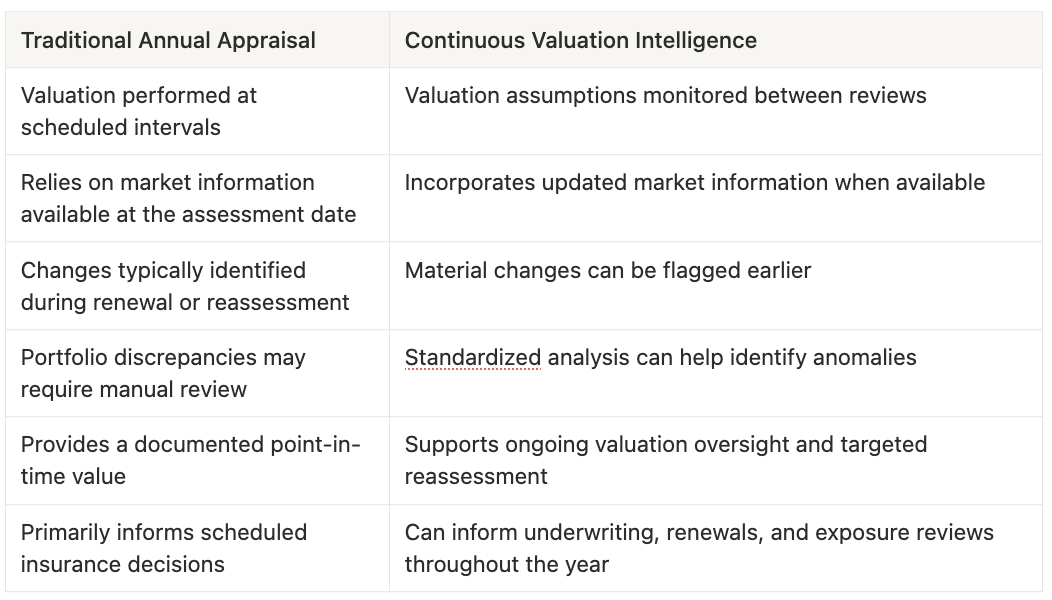
A continuous approach does not necessarily mean that every asset receives a new certified appraisal every day. Instead, it means that insurers and asset owners have a mechanism for detecting meaningful changes and deciding when further analysis is justified.
What Continuous Market Intelligence Actually Requires
Continuous valuation intelligence is more than a dashboard displaying updated equipment prices. For renewable energy insurance, it requires several connected capabilities.
Market-Referenced Replacement Cost Analysis
Insurers need visibility into the economic inputs affecting the cost of replacing renewable energy assets. This may include equipment prices, technology specifications, installation costs, and other project-specific replacement requirements. These inputs must be interpreted together rather than treated as isolated market indicators.
Asset-Level Valuation Models
Portfolio averages are useful for identifying broad trends, but insurance decisions frequently depend on the characteristics of individual assets. Asset-level models can incorporate location, capacity, equipment configuration, installation type, and other relevant characteristics to produce more differentiated estimates.
Consistent Portfolio-Level Methodology
For insurers managing hundreds or thousands of renewable energy sites, consistency is essential. A standardized methodology makes it easier to compare assets, identify unusual valuations, and understand differences between declared and modeled replacement costs. It also supports a more repeatable review process across underwriting teams and renewal cycles.
Transparent Assumptions and Supporting Evidence
An updated valuation is only useful if decision-makers understand how it was derived. Insurers, brokers, lenders, and asset owners need access to relevant assumptions, inputs, valuation dates, and methodological explanations. This transparency becomes especially important when valuations are challenged during underwriting or claims discussions.
Material Change Detection
Not every market movement requires an insurance adjustment. A useful intelligence framework distinguishes ordinary market fluctuations from changes significant enough to justify investigation. For example, a material difference between an asset's declared value and its current modeled replacement cost could trigger a targeted review.
This allows valuation resources to be directed toward assets where discrepancies may have the greatest financial impact.
Why This Matters Across the Insurance Lifecycle
Continuous valuation intelligence can support more than annual policy renewal.
Its applications extend across the insurance lifecycle, from initial exposure assessment to post-loss recovery.
At underwriting: Insurers can compare declared asset values against current replacement cost estimates, identify unusual assumptions, and request additional evidence where needed.
At renewal: Brokers and asset owners can review whether insured values remain appropriate before submitting updated schedules of values.
During portfolio acquisition or financing: Investors, lenders, and insurers can evaluate asset values using more consistent and current assumptions.
Following a loss: Current replacement cost information can support damage evaluation, while separate salvage and residual value assessments can help inform recovery decisions.
During decommissioning: Residual value and recovery analysis can provide a clearer understanding of the potential economic value remaining in equipment and materials.
These decisions require different valuation bases. Replacement cost, fair market value, and salvage value should not be treated as interchangeable.
The advantage of an integrated intelligence framework is the ability to support these distinct decisions with more consistent asset information and appropriate valuation methodologies.
The Role of AI and Algorithmic Valuation
Advances in data processing and algorithmic modeling are making it more practical to evaluate renewable energy assets at scale.
Rather than manually reconstructing every valuation from the beginning, structured models can analyze asset characteristics, apply relevant market inputs, and identify differences that warrant further review. For large insurance portfolios, this can reduce the effort involved in screening values and prioritizing detailed assessments.
But automation alone does not make a valuation defensible. The underlying data must be reliable. The methodology must be appropriate for the intended use. Material assumptions must be documented. And expert review remains important when the complexity or significance of an asset demands it.
The value of algorithmic valuation is not simply producing numbers faster. It is making consistent, evidence-based valuation analysis more accessible across an entire portfolio.
How Buckstop Is Bringing Market Intelligence Into Renewable Energy Valuation
At Buckstop, we believe renewable energy insurance valuation should reflect the market conditions that shape an asset's economic exposure, rather than relying exclusively on historical values or infrequent assessments.
Our approach combines asset-level analysis, market-referenced valuation models, and transparent methodology to help insurers, brokers, lenders, and asset owners make more informed decisions.
Through Valuation Studio, Buckstop supports scalable renewable energy asset valuation using structured asset information and algorithmic analysis.
Our Certified Appraisals provide a formal valuation pathway for situations requiring independent, documented assessments.
And through Residual Value Intelligence, we help stakeholders better understand the secondary-market and recovery economics of renewable energy equipment.
Together, these capabilities support a more connected approach to valuation across underwriting, financing, asset management, and recovery.
The goal is not to replace professional judgment or eliminate certified appraisals. It is to give decision-makers better information about asset values and the assumptions behind them.
The Future of Renewable Energy Insurance Valuation Is More Responsive
As renewable energy portfolios grow, the gap between static insurance schedules and changing market conditions becomes increasingly difficult to ignore. Annual appraisals will continue to serve an important purpose, especially when formal documentation and independent valuation opinions are required.
But relying on those assessments as the only source of valuation information can leave insurers and asset owners without sufficient visibility between review periods. Continuous market intelligence offers a more responsive approach. It makes it possible to identify material valuation changes, investigate inconsistencies, and update assumptions when the evidence warrants it.
For renewable energy insurance, the next step is not simply more frequent appraisals. It is a valuation process that stays informed even when a formal appraisal is not taking place.
Know What Your Renewable Energy Assets Are Worth Today
Historical asset values do not always reflect current replacement economics. Buckstop helps insurers, brokers, and asset owners evaluate renewable energy assets using market-referenced analysis and decision-grade valuation methodologies.
Explore Buckstop's Valuation Studio → https://www.buckstop.com/solutions/valuation-studio

Kristen Shaw
She brings extensive experience in technology marketing, with her 20+ year of experience. Kristen is also the National Marketing Chair for Cleantech Open and is actively involved in the climate technology community. At Buckstop, her work focuses on helping asset owners, lenders, insurers, and investors better understand the value of renewable energy infrastructure throughout its lifecycle.
